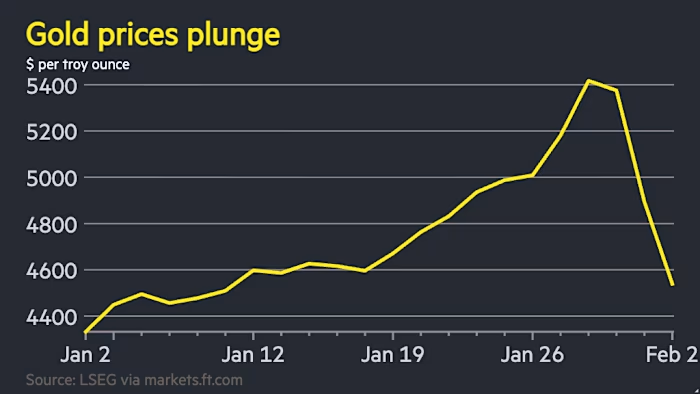
In a dramatic shift on Monday, gold and silver prices plummeted as the unprecedented rally in precious metals came to an abrupt halt, sending shockwaves through global equity markets. Early trading in London showed gold prices down by 7 percent, settling at $4,538 per troy ounce, while silver experienced an even more significant decline of 13 percent, falling to $74. These downward trends, which began late last week, marked a stark contrast to the metals’ recent surge, driven by geopolitical tensions and concerns regarding the US Federal Reserve’s independence.
The market response was influenced by Donald Trump’s recent nomination of Kevin Warsh, a former Fed governor, as the next chair of the US central bank. This announcement appeared to assuage fears that Trump’s successor would pressure the Fed into aggressive interest-rate cuts, allowing investors to reassess their positions in safe-haven assets. As precious metals took a hit, Asian stock markets similarly faltered, burdening shares of gold and silver mining companies.
The declines extended beyond precious metals, as prices for industrial metals such as copper and aluminum also fell by approximately 3 percent. South Korea’s Kospi Index led the downturn in Asia with a significant 5.3 percent drop, while Hong Kong’s Hang Seng Index was down 2.6 percent. In the United States, futures tracking both the S&P 500 and Nasdaq 100 experienced declines of 1.4 and 1.8 percent, respectively, and the Stoxx Europe 600 futures decreased by 0.9 percent.
Market analysts noted that the slide in equity prices was exacerbated by investors who had taken leveraged positions in gold and silver and were now compelled to liquidate other assets to maintain their margin requirements. Hao Hong, chief investment officer of Lotus Asset Management, commented, “People are selling the high flyers to raise cash,” emphasizing the impact of margin calls on the broader market.
CME Group, the leading operator of derivatives exchanges globally, increased margin requirements for gold and silver futures on Friday, a move triggered by the steep declines observed in the metals’ prices. This increase necessitated that investors utilizing leverage either top up their margins or liquidate positions. Prashant Bhayani, chief investment officer for Asia at BNP Paribas Wealth Management, pointed out, “Those margin changes have to have an impact [on asset prices] in the short term.”
Investors previously driving the rally had been compelled by rising demand from private investors, who opted for exchange-traded funds and physical bullion as a safeguard against swelling fiscal expenditures in developed economies and related geopolitical uncertainties. Raymond Cheng of Standard Chartered expressed an optimistic view, stating that gold trading at $4,650 was a prime opportunity for investment amidst growing uncertainty in government spending in the United States. He emphasized that the “Trump risk premium” remains relevant, suggesting that the former president’s fiscal policies would likely continue to be expansionary regardless of the Fed chair.
The fallout from falling precious metal prices significantly impacted South Africa’s stock market, heavily reliant on the mining sector, which saw losses of up to 6.8 percent. Notably, shares of Newmont Corporation, a prominent gold mining company listed in Australia, plunged by 10 percent, while shares of Zijin Gold International decreased by over 8 percent. Bhayani likened the current corrections in the market to the behavior of so-called “meme stocks,” arguing that markets which rise as sharply as they did rarely correct without significant volatility.
In currency markets, the dollar saw a slight increase of 0.2 percent against a basket of major trading partners, while yields on 10-year US Treasuries fell by 0.02 percentage points to 4.21 percent, indicating a shift in investor sentiment as bond yields moved inversely to prices.