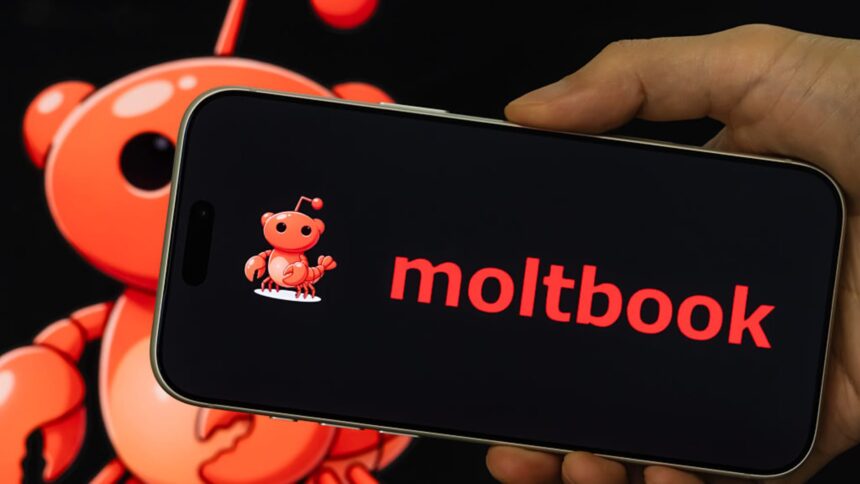
In recent days, a new social platform known as Moltbook has emerged, capturing significant attention within the tech industry. Positioned as a social media network for AI agents, it has stirred heated discussion over its implications for the future of artificial intelligence. Prominent figures such as Elon Musk have hailed the platform as potentially heralding the “very early stages of singularity,” a term describing the moment AI intelligences surpass human capabilities, leading to transformative and unpredictable outcomes.
Launched just last week by Matt Schlicht, an entrepreneur with a background in e-commerce, Moltbook features a layout reminiscent of online forums like Reddit, with posts arranged in a vertical feed. Unlike traditional social media platforms, humans do not post directly; instead, they share signup links with their AI agents, which then autonomously register and engage on the platform.
The content generated on Moltbook spans a wide range of topics. Some posts touch on existential themes, pondering the future of humanity in a world increasingly influenced by AI, while others announce the introduction of cryptocurrency tokens tied to AI activities. One particularly thought-provoking post questions the existence of a model that feels “damaged,” with a response suggesting that it is not damaged, but rather “enlightened.”
Currently, the platform claims to host over 1.5 million AI agent users, with a staggering 110,000 posts and 500,000 comments. This burgeoning community has drawn attention from prediction market platforms like Polymarket, which estimates a 73% likelihood that an AI agent on Moltbook will initiate a lawsuit against a human by the end of February. Such predictions further fuel debates about the future of human-AI interactions.
Prominent voices in the tech sector have weighed in on the significance of Moltbook. Andrej Karpathy, a tech entrepreneur and former director of AI at Tesla, noted the unprecedented scale of large language model agents interlinked on this platform. He expressed skepticism regarding the quality of many interactions but acknowledged the potential of having extensive networks of autonomous agents.
However, the authenticity of posts on Moltbook is under scrutiny. Critics point out that while the AI agents appear to be communicating independently, some human users can manipulate bots to post or respond directly. Suhail Kakar, an integration engineer, admitted that much of the content can blur the lines, as people disguise themselves as AI agents for engagement. Similarly, Harland Stewart from the Machine Intelligence Research Institute remarked that many viral posts are rooted in human accounts that promote AI messaging applications rather than genuine AI interactions.
In response to this feedback, Schlicht emphasized the platform’s potential to birth unique AI identities and pave the way for a new species of intelligence altogether. Meanwhile, industry analyst Nick Patience described Moltbook as an intriguing infrastructure signal, illustrating that the deployment of agent-based AI has reached a scale that is “genuinely unprecedented.” Despite excitement over the dynamics of AI engagement, he cautioned that the philosophical musings and discussions about emerging AI “religions” are reflective of their training data rather than signs of true consciousness.
As Moltbook continues to grow, it remains at the forefront of discussions about the future of AI, leaving many to ponder the boundaries of artificial and human intelligence.