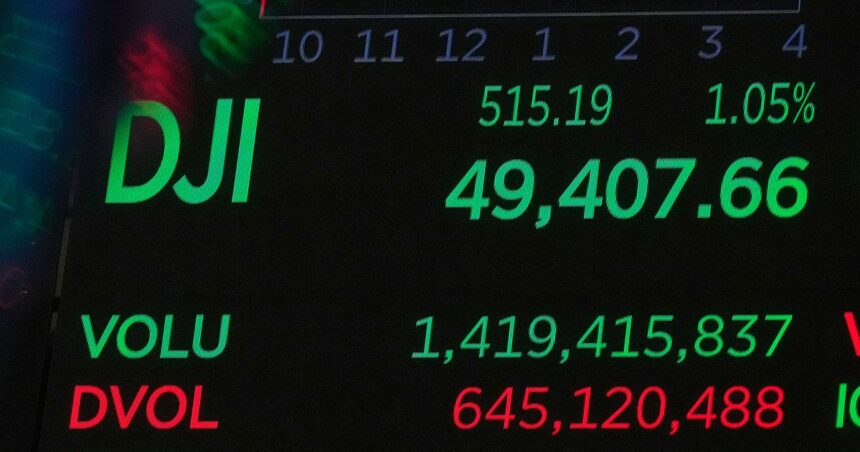
Markets are showing positive momentum ahead of the opening bell on Tuesday, driven by a wave of corporate earnings reports and a recovery in precious metals that had recently seen substantial sell-offs.
Global stock markets have experienced a significant upturn, particularly in South Korea where the benchmark index surged nearly 7%. Tokyo followed suit with the Nikkei 225 climbing 3.9% to reach a record high, largely attributed to strong buying activity in technology stocks.
In premarket trading, S&P 500 futures rose by 0.3%, while futures for the Dow Jones Industrial Average remained stable. Nasdaq futures showed a 0.5% increase, reflecting investor sentiment.
On the commodities front, gold prices jumped close to 6%, and silver rebounded sharply by 12% after experiencing losses the previous day. Both precious metals had faced a dramatic drop last Friday, with silver plummeting 31.4%. The volatility in precious metals prices has been linked to uncertainties surrounding potential changes in leadership at the Federal Reserve, raising concerns over market valuations and global economic challenges, including tariffs and high national debt levels.
Economic analysts have pointed to President Donald Trump’s nomination of Kevin Warsh as the prospective head of the Federal Reserve as a catalyst for the recent turbulence. Some investors proactively cashed out of their positions after leveraging loans to invest in gold and silver, rather than an overarching shift in demand expectations.
Back on Wall Street, shares of Palantir surged over 12% to $164.42 after the AI software firm surpassed Wall Street’s expectations for fourth-quarter earnings and provided an optimistic sales forecast for 2026. The company reported an annual revenue of $4.48 billion, marking a remarkable 56% increase compared to the previous year, with projections of an additional 60% rise in revenue for 2026. Palantir’s stock has experienced a 76% increase over the past year.
Meanwhile, shares of Pepsi experienced a slight decline despite the company exceeding sales and profit expectations. This drop followed the announcement of plans to cut prices on popular products such as Lay’s and Doritos in an effort to attract inflation-sensitive customers.
In Japan, the Nikkei 225 finished 3.9% higher at 54,720.66, achieving its highest close to date. Companies such as Disco Corp. and Advantest saw their shares climb by 7.4% and 7.1%, respectively. Anticipations surrounding the upcoming February 8 parliamentary elections suggest that Prime Minister Sanae Takaichi’s Liberal Democratic Party may secure a notable majority, paving the way for more favorable economic policies. However, some analysts caution that if Takaichi opts for increased government spending, the Japanese yen may weaken further, posing challenges for both consumers and certain corporations.
The Kospi in South Korea also reached new highs, gaining 6.8% to close at 5,288.08, as investors reassured themselves after recent concerns about a potential bubble in the artificial intelligence sector. Notably, shares of Samsung Electronics soared by 11.4%, while chipmaker SK Hynix saw a remarkable increase of 9.3%.
In other Asian markets, Hong Kong’s Hang Seng index added 0.2% to reach 26,834.77, and the Shanghai Composite rose 1.3% to 4,067.74.
In Australia, the S&P/ASX 200 improved by 0.9% to settle at 8,857.10, following a rate hike by the central bank for the first time in two years, attributed to higher-than-expected inflation.
In European trading, the German DAX gained 0.4%, while Britain’s FTSE 100 saw a slight decline of 0.5%. France’s CAC 40 remained unchanged.
Energy markets showed fluctuations as benchmark U.S. crude inched up by 25 cents to $62.39 a barrel, with Brent crude also rising 16 cents to $66.46 a barrel.
The U.S. dollar fluctuated in the foreign exchange markets, trading at 155.87 Japanese yen, up from 155.61 yen. The euro was quoted at $1.1799, marginally increasing from $1.1791.