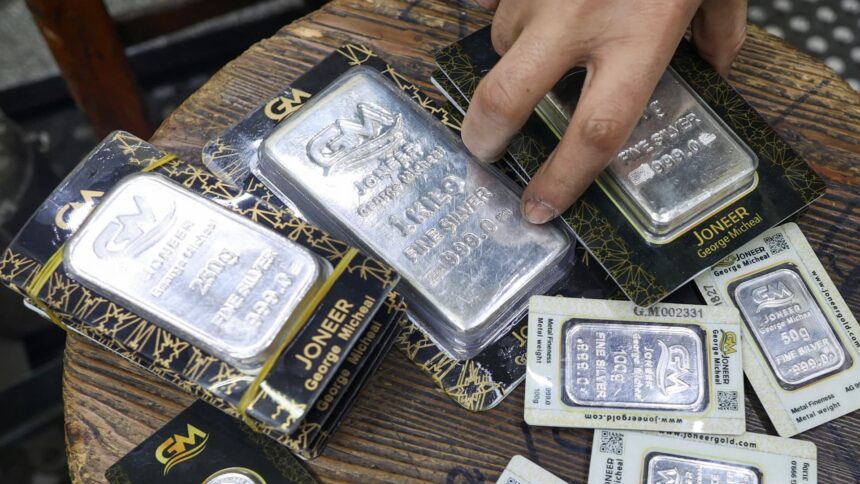
Silver’s market dynamics have reached a level of instability that has left investors grappling with uncertainty. Recent trading activity highlights this volatility, with price swings exceeding 100% in the near term. Throughout the year, silver has experienced an astonishing 11 price movements of 5% or more in either direction, leaving many to question when and where the bottom might occur.
On a particularly tumultuous Thursday, spot silver prices dropped as much as 10% before stabilizing to a slight gain of over 2%, reaching approximately $73 per ounce. In New York, silver futures followed a similarly erratic course, registering a decrease of over 5% to settle at around $72.34 per ounce. This comes on the heels of a significant plunge of nearly 30% from record highs reached earlier in the year. Following this sharp drop, prices briefly rallied earlier in the week but faced another dramatic decline of 19% on Thursday.
Market analysts at UBS observed that the recent downturn seemed to be more a reflection of broader market anxiety rather than a fundamental collapse. They cautioned that the extreme volatility complicates short-term investment strategies. “Given the current one-month volatility in silver has surpassed 100%, expect significant price fluctuations in the near term,” they noted in their latest report. UBS further predicted challenges for silver to maintain prices above $85 per ounce without consistent investment demand.
In terms of broader market activity, data reveals that silver has recorded 11 significant price shifts this year, underscoring its turbulent performance. UBS, while advocating caution on short-term positions, maintains that the long-term fundamentals remain strong. They expect factors such as lower nominal and real interest rates, global debt concerns, and projected global economic recovery in 2026 to drive silver prices higher. The bank estimates a market deficit of almost 300 million ounces this year, with investment demand projected to exceed 400 million ounces, although elevated prices might limit industrial usage.
The surge in option prices presents opportunities for investors aiming to establish a price floor rather than betting on further gains. With one-month volatility hovering around 80%, UBS suggests that strategies focused on keeping silver prices above $65 per ounce appear more favorable, reflecting a belief that while price movements may remain volatile, a sharp decline below this threshold is unlikely in the near term.
Research head at MKS Pamp, Nicky Shiels, pointed out that the current behaviour of silver doesn’t resemble past bull markets characterized by supply constraints. Instead, she remarked that silver’s volatility resembles that of a “meme stock or commodity,” with retail investment flows significantly influencing market movements. She forecasts that silver may spend the upcoming weeks adjusting to the recent rally’s excesses, with potential lows of around $60 per ounce.
OCBC’s managing director of investment strategy, Vasu Menon, echoed concerns about the current market sentiment while affirming that the long-term case for silver remains strong for those willing to endure short-term volatility. He described silver as a hybrid asset, possessing characteristics of both precious and industrial metals, as well as speculative elements. Menon has set a long-term price target for silver at $134 per ounce by March 2027, highlighting the metal’s extensive applications in sectors such as solar energy, catalysis, and electronics.
As the silver market continues to navigate these turbulent waters, investors are left to consider their strategies amidst a backdrop of pronounced volatility and shifting fundamentals.