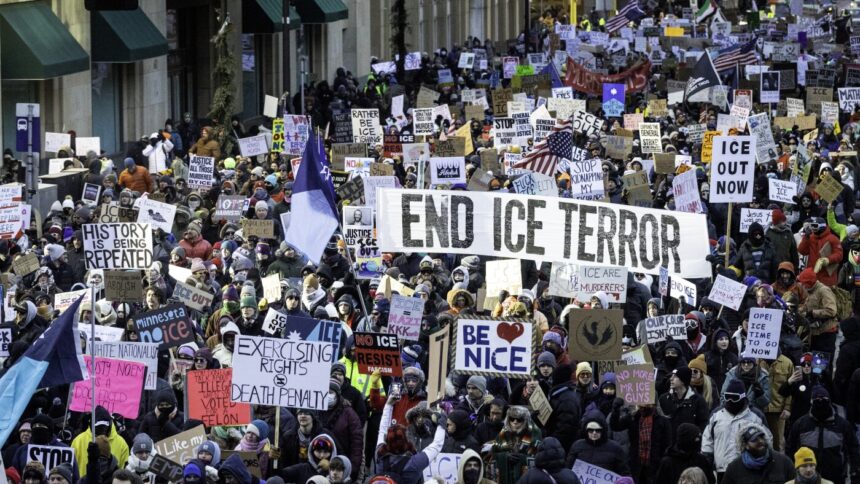
Demonstrators marched in Minneapolis recently, calling for an end to ICE operations in Minnesota, highlighting a broader movement against immigration enforcement under the Trump administration. As tensions rise, various individuals across the country are joining a boycott targeting major tech companies, which many believe have not sufficiently opposed the government’s immigration policies.
In Portland, Oregon, residents Brittany Trahan and Lisa Shannon have begun shifting their consumer habits to protest these policies. Trahan has opted to purchase DVDs rather than subscribe to services like Netflix and Apple TV, while Shannon has started using public transit instead of Uber. In McDonough, Georgia, Brian Seymour II is choosing to support local businesses over shopping online via Amazon, uncomfortable with the implications of such corporations’ ties to immigration enforcement.
The boycott, dubbed “Resist and Unsubscribe,” originated from influential podcaster and business commentator Scott Galloway. He expressed frustration with the administration’s perceived apathy towards public dissent, especially following incidents in Minneapolis where federal officers shot and killed two U.S. citizens. Galloway suggests that financial pressure may be the most effective means of enacting change, arguing that companies respond when their financial well-being is threatened.
Several businesses in Minneapolis engaged in protests against ICE operations recently, with many closing their doors in solidarity. Galloway’s campaign encourages consumers to avoid companies that collaborate with U.S. Immigration and Customs Enforcement (ICE) or significantly influence the economy. He believes that using financial withdrawal as a protest tool is both powerful and appropriate in a capitalist society. The campaign’s website has gained traction, registering 250,000 unique page views in a single day.
Although the White House has not commented on the boycott, a spokesperson cited increased assaults on immigration officers as a consequence of anti-ICE sentiment, despite a lack of corroborative public records. Companies listed by Galloway have not responded to inquiries regarding the boycott.
In light of Trump’s administration, recent boycotts have emerged, such as Canadians shunning American products due to new tariffs and Tesla owners selling their vehicles in protest. Comparatively, “Resist and Unsubscribe” aims for a broader impact. Lucy Atkinson, a professor in advertising, noted the difficulty of stepping back from ingrained services like Amazon, but emphasized that doing so could lead to reduced consumer dependence, potentially contributing to lasting change.
Respondents like Trahan have expressed newfound motivation to join the boycott after feeling frustrated with the efficacy of typical political protests. She canceled several subscriptions, including one to her favorite show on Apple TV, highlighting the conviction behind her decision. Similarly, Shannon cited personal grievances against companies involved with the Trump administration as part of her rationale for joining the effort.
Seymour, motivated by his belief in consumer power, terminated subscriptions to various services, also discovering local businesses through his new shopping habits. Others, like Jake Ward from Colorado, have noted minimal disruption to their routines after dropping high-profile subscriptions.
While some participants suggest that a one-month boycott may not wield enough impact to influence corporate behavior, Galloway acknowledges this concern. He emphasizes the opportunity to empower individuals to make choices about their spending. The campaign serves as a rallying cry for those seeking to leverage economic pressure against policies perceived as unjust, indicating a shift in consumer consciousness regarding corporate responsibility in political matters.