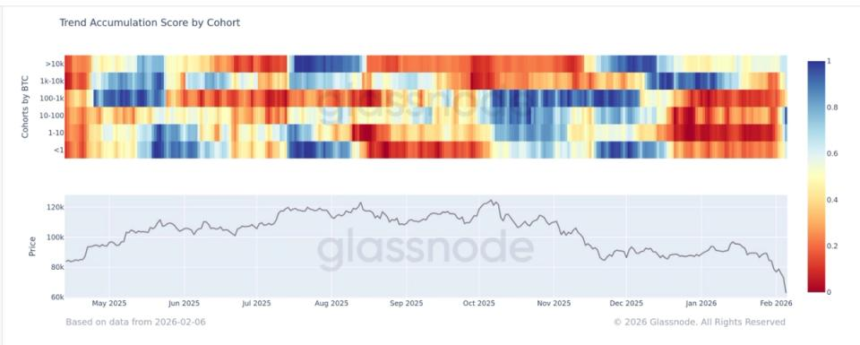
As February rolled in, the cryptocurrency market witnessed notable volatility, with Bitcoin trading around $80,000. At that juncture, major holders, often referred to as “whales,” began cautiously entering the market, while retail investors appeared to be fleeing in response to the price fluctuations.
However, this cautious optimism swiftly turned to concern when Bitcoin’s price plummeted to approximately $60,000 on February 5. This drastic drop marked one of the most significant capitulation events in Bitcoin’s history. In the aftermath, the market has displayed a pronounced shift as nearly all investor cohorts adopt an accumulation strategy, suggesting that many are re-evaluating the asset’s value.
Analytics firm Glassnode released findings illustrating this changing investor behavior through its Accumulation Trend Score by cohort. This metric replaces previous trends by gauging the relative strength of accumulation across various wallet sizes, factoring in both the entity size and the BTC accumulated over the last 15 days. A score approaching 1 signifies accumulation, whereas a score near 0 indicates a more distributed approach.
Currently, the aggregate Accumulation Trend Score has risen to 0.68, surpassing the 0.5 threshold for the first time since late November. This uptick is significant as it coincides with a prior local bottom formation around the $80,000 mark. The most aggressive buying appears to be occurring in wallets holding between 10 and 100 BTC, which have actively bought in as prices dipped toward the $60,000 level.
While uncertainty looms regarding whether this marks the ultimate price bottom for Bitcoin, it is clear that following a dramatic downturn of more than 50% from its peak in October, investors are once again identifying value in the digital currency. This evolving market sentiment indicates a potential pivot toward a more synchronized accumulation phase among various investors.