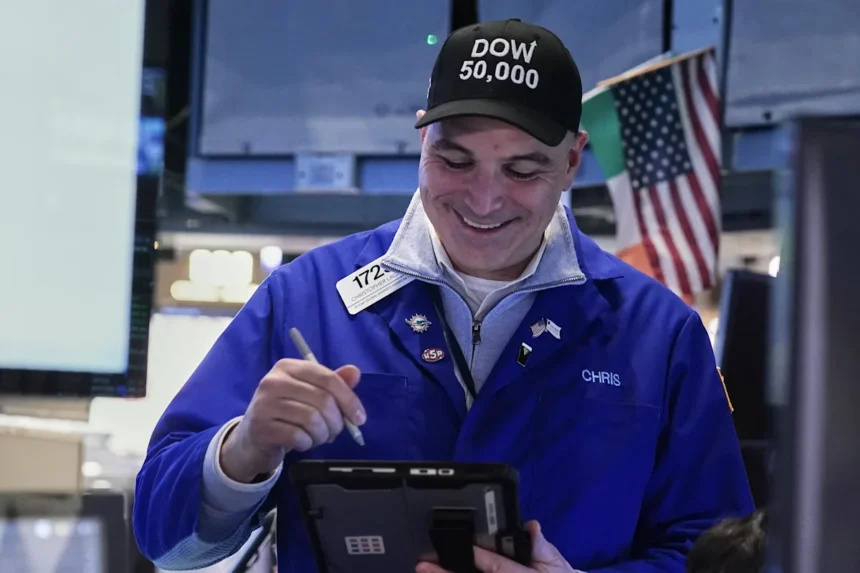
U.S. stock futures saw a modest increase Sunday night as investors prepared for a week filled with significant economic data and corporate earnings reports. This comes after a tumultuous period that concluded with the Dow Jones Industrial Average achieving a historic high by surpassing 50,000 for the first time on Friday.
Futures for the S&P 500 rose by 0.4%, while Nasdaq 100 futures climbed approximately 0.6%. Dow futures experienced a slight increase of 0.2%. On Friday, the Dow soared over 1,200 points, or 2.5%, marking a noteworthy milestone with its first closing above the 50,000 mark, briefly surpassing it during intraday trading. Both the S&P 500 and Nasdaq Composite finished with gains around 2%, as Wall Street rebounded from a week characterized by significant losses primarily driven by a sell-off in technology stocks.
The technology sector bore the brunt of the week’s downturn, with software companies particularly affected as a broader risk-averse sentiment took hold. This angst stemmed from escalating expenditures on artificial intelligence, with major players such as Amazon, Google, Meta, and Microsoft collectively planning to invest $650 billion in a competitive push for technological advancement, with no clear leader emerging.
As the markets attempt to maintain their upward momentum, they will confront a schedule laden with key economic indicators. The January employment report, originally set for release last Friday but delayed due to a partial government shutdown, is now anticipated on Wednesday. Analysts have tempered expectations, particularly after the ADP reported a mere 22,000 private-sector job additions last month, a stark decline from the 140,000 reported for the same timeframe last year.
Additionally, January’s consumer price index is set to be unveiled on Friday, after its own postponement related to the government shutdown. This week will also see earnings reports from notable companies including Coca-Cola, McDonald’s, Cisco, and ON Semiconductor, which are expected to influence market sentiments.
These earnings will play a crucial role in shaping perceptions of the Federal Reserve’s potential interest rate trajectory, especially as investors consider the implications of President Trump’s nominee to succeed Jerome Powell as Fed Chair, former Fed governor Kevin Warsh. Warsh is often viewed as a policy hawk and was a member of the central bank during the financial crisis of 2008. However, his nomination only provided a short-lived boost to the U.S. dollar, as the dollar index has decreased by 10% since Trump took office.
Overall, the stock market is gearing up for a busy week that could significantly impact investor sentiment and economic outlooks moving forward.