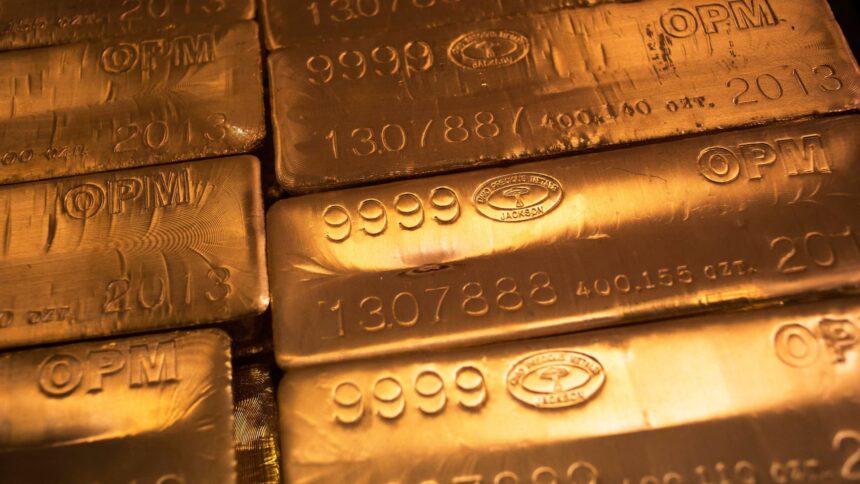
Gold prices experienced a notable uptick on Monday, driven primarily by a weakening U.S. dollar as investors prepared for a week filled with critical economic indicators that may shed light on the Federal Reserve’s monetary policy direction. Spot gold rose 1.2%, reaching $5,018.56 per ounce by 9:30 a.m. ET, thereby extending a rally that began on Friday, which saw a 4% increase in prices. Concurrently, U.S. gold futures for April delivery saw a 1.3% rise, climbing to $5,042.20 per ounce.
The dollar’s decline, down 0.8% to a one-week low, has made gold, priced in U.S. currency, more affordable for international buyers. Bart Melek, the global head of commodity strategy at TD Securities, noted that the day’s significant movement in gold prices was directly linked to the behavior of the U.S. dollar, and he highlighted growing expectations for disappointing economic data, particularly regarding employment figures.
Market participants are particularly attentive to the upcoming releases of U.S. nonfarm payrolls, consumer price indexes, and initial jobless claims, which are anticipated to provide fresh insights into monetary policy. According to a Reuters poll, nonfarm payrolls are estimated to have increased by 70,000 in January. Analysts believe that lower interest rates are likely to support gold prices, as they reduce the opportunity cost associated with holding non-yielding assets like gold.
In a related development, the People’s Bank of China reported that the country’s central bank continued its gold purchasing campaign into January for the 15th consecutive month. This trend has reinforced a market sentiment that favors gold, particularly amid ongoing geopolitical uncertainties. Melek emphasized that these developments have psychological implications for investors, further driving interest in gold.
Meanwhile, the silver market mirrored gold’s upward trend, with spot silver gaining 2.9% to reach $80.22 per ounce, building on a nearly 10% increase from the previous session. The metal recently achieved an all-time high of $121.64 on January 29. In contrast, spot platinum experienced a slight decline of 0.2%, settling at $2,092.95 per ounce, while palladium remained stable at $1,707.25.
Nitesh Shah, a commodities strategist at WisdomTree, commented on the trends affecting platinum and palladium markets, speculating that a slowdown in electric vehicle sales has not yet materialized despite various policy relaxations. Consequently, he forecasts potential deceleration for these metals following a bullish phase in 2025.