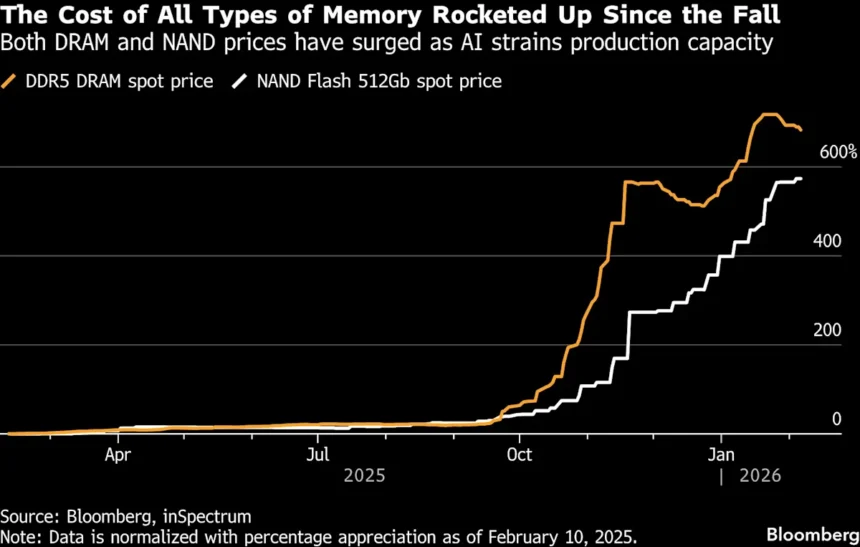
The recent surge in memory chip prices has created a stark divide in the stock market, leading to significant challenges for various sectors while benefiting memory producers. Investors are beginning to assess the sustainability of this trend and the impact it will have on companies reliant on memory chips for their products.
A notable divergence has emerged as a Bloomberg gauge of global consumer electronics manufacturers has dropped 12% since late September, while memory chip makers, including industry giants like Samsung Electronics Co., have seen their stock values soar by over 160%. Analysts are now questioning how much of this growth is already reflected in current stock prices.
Vivian Pai, a fund manager at Fidelity International, highlighted that market valuations seem to assume a return to normal conditions within one or two quarters. However, she suggests that the tight conditions in the memory chip market might persist for a longer period, perhaps throughout the remainder of the year. This sentiment is echoed in the earnings reports of several companies, where memory chip shortages and rising costs have become frequent topics of discussion.
Recent examples include Qualcomm Inc., which experienced an over 8% drop in its stock price after indicating that memory constraints would impact smartphone production. Similarly, Nintendo’s shares fell significantly after warning about margin pressures stemming from these shortages. Logitech International SA has also seen its stock fall nearly 30% since November due to the negative outlook on PC demand associated with rising chip prices. Chinese automakers and smartphone manufacturers like BYD Co. and Xiaomi Corp. have likewise faced sluggish stock performance, attributed to ongoing fears regarding chip availability.
Charu Chanana, chief investment strategist at Saxo, noted that discussions about memory prices have shifted from background concerns to being prominently featured in earnings reports. While the market appears to have priced in the ongoing tight supply and elevated prices, questions remain regarding the duration of these conditions.
The landscape is further complicated by increasing concerns about demand as major U.S. companies ramp up spending on AI infrastructure, which may intensify the shortages of memory chips. The pivot toward high-bandwidth memory to support AI applications has diverted production from traditional DRAM, contributing to what some analysts are calling a “supercycle” in the memory sector. This phenomenon disrupts the typical cycles of boom and bust associated with memory supply and demand.
Spot prices for DRAM have surged by more than 600% recently, despite weak demand for end goods like smartphones and vehicles. Additionally, the burgeoning demand for NAND chips and related storage technology driven by AI applications is further inflating costs within those segments.
Memory chip manufacturers have emerged as standout performers in an otherwise turbulent tech market. Notably, SK Hynix Inc., a key supplier of high-bandwidth memory, has seen its shares climb over 150% since late September. Other significant players, such as Kioxia Holdings Corp. and Taiwan’s Nanya Technology Corp., have recorded gains of approximately 280% during that period, while Sandisk Corp. has seen an astonishing increase of over 400%.
Fund manager Jian Shi Cortesi from GAM Investment Management observed that the current memory cycle has already surpassed previous cycles in both duration and intensity, with no signs of diminishing demand momentum on the horizon. This ongoing trend, combined with the shifting landscape of technology and memory production, suggests that companies in this space will continue to face dynamic and potentially volatile conditions in the foreseeable future.