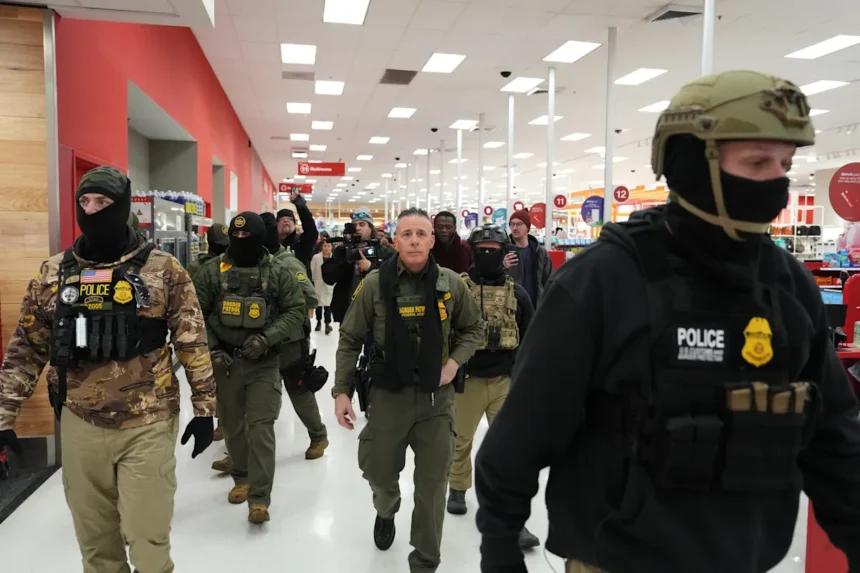
Activists gathered at over two dozen Target locations across the United States on Wednesday, aiming to pressure the retailer into publicly opposing a five-week immigration crackdown in Minnesota. Organized by ICE Out Minnesota, a coalition of community groups, labor unions, and religious leaders, the protests included sit-ins and are set to last a full week.
Target’s headquarters is located in Minneapolis, where federal officers recently shot two residents involved in anti-ICE protests. Elan Axelbank, a member of the Minnesota chapter of Socialist Alternative, expressed frustration, stating, “They claim to be part of the community, but they are not standing up to ICE.” Axelbank led a protest in Dinkytown, Minneapolis.
Demonstrations were also expected in cities across the nation, including St. Paul, Boston, Chicago, and Seattle, among others. Despite the ongoing protests, Target declined to comment.
The retailer first came under scrutiny after a video surfaced of federal agents detaining Target employees in Richfield, a Minneapolis suburb. Luis Argueta, a spokesperson for the immigrant advocacy group Unidos Minnesota, indicated the Richfield store would be a focal point for protests, emphasizing demands for Target to deny federal agents access to stores without judicial warrants.
Legal opinions suggest that federal agents, including Border Patrol and Immigration and Customs Enforcement personnel, may enter public areas of businesses without warrants, raising concerns among activists about the treatment of immigrants in these public spaces.
Target’s CEO, Michael Fiddelke, recently commented on community violence in a video message but did not address the immigration crackdown directly. Following the fatal shooting of ICU nurse Alex Pretti during an immigration enforcement operation, Fiddelke was among a group of Minnesota CEOs who signed an open letter advocating for de-escalation and a collaborative approach to find solutions.
These protests follow a year of turmoil for Target, which previously faced boycotts over a rollback of its diversity and inclusion initiatives. Critics decried this decision as a betrayal of the company’s philanthropic commitments to fight racial disparities.
While the protests represented only a fraction of Target’s nearly 2,000 stores, retail expert Neil Saunders noted the negative attention could serve as a distraction for the company, which is already grappling with ongoing sales struggles.
The protests also drew support from a national coalition of Mennonite congregations, which organized demonstrations at various Target stores to call for congressional action to defund ICE. Though not formally connected to ICE Out Minnesota, these groups consistently echo the grassroots efforts in Minneapolis. Rev. Joanna Lawrence Shenk from First Mennonite Church expressed the coalition’s desire to protect vulnerable immigrant communities through their actions and communal expressions of support.
As the week of protests unfolds, demands for Target to take a definitive stance on immigration enforcement continue to grow louder, shedding light on wider social issues intersecting with corporate policies.