In a notable announcement, Restaurant Brands International has reported strong quarterly earnings that exceeded market expectations, primarily driven by robust international growth across its brands. The latest financial figures reflect the company’s performance for the period ending December 31.
The earnings per share reached 96 cents, adjusted for various items, slightly surpassing analysts’ expectations of 95 cents. Revenue stood at $2.47 billion, surpassing the predicted $2.41 billion. Despite this positive outlook, the net income attributable to shareholders decreased to $113 million, or 34 cents per share, down from $259 million, or 79 cents per share, in the same quarter last year.
When adjusted to exclude transaction costs and restructuring expenses, the earnings showed a notable improvement, with adjusted earnings reported at 96 cents per share. The company’s net sales experienced a significant rise of 7.4%, amounting to $2.47 billion. Organic revenue growth, which accounts for currency fluctuations and refranchising, increased by 6.5%.
Restaurant Brands has reported a 3.1% increase in same-store sales, primarily invigorated by strong growth in international markets. Outside of the U.S. and Canada, same-store sales surged by 6.1%. Notably, the international segment of Burger King showed impressive same-store sales growth of 5.8%, outperforming analysts’ projections of 3.7%.
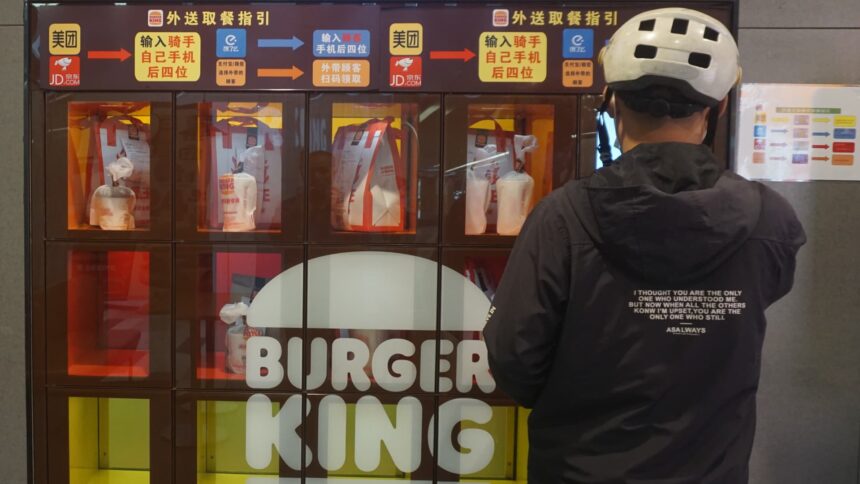
In line with its growth strategy, the company is making strides to expand its international footprint. Recently, Restaurant Brands announced a joint venture aimed at accelerating the expansion of Burger King in China. Under this partnership, which was finalized in late January, CPE, a leading Chinese alternative asset manager, has acquired approximately 83% of Burger King China, leaving Restaurant Brands with a minority stake of about 17% and a position on the board of directors.
Another of Restaurant Brands’ key segments, Tim Hortons, reported a same-store sales increase of 2.9%, although this fell short of the 3.8% growth anticipated by Wall Street. Tim Hortons accounted for 46% of the company’s total revenue during the quarter. In contrast, Burger King’s overall same-store sales growth of 2.7% exceeded estimated growth rates of 2.4%.
However, Popeyes struggled during this period, with a significant same-store sales decline of 4.8%, which was more severe than the 2.4% decrease predicted by analysts. To rejuvenate this brand, Restaurant Brands has recently appointed Burger King veteran Peter Perdue to spearhead the U.S. and Canadian business operations of Popeyes. Additionally, Matt Rubin, who has a history with Popeyes, has been designated as the new chief marketing officer for the chain.
As part of its ongoing strategy to enhance revenue and market presence, Restaurant Brands is set to share further insights and growth ideas at its investor day event scheduled for February 26 in Miami.