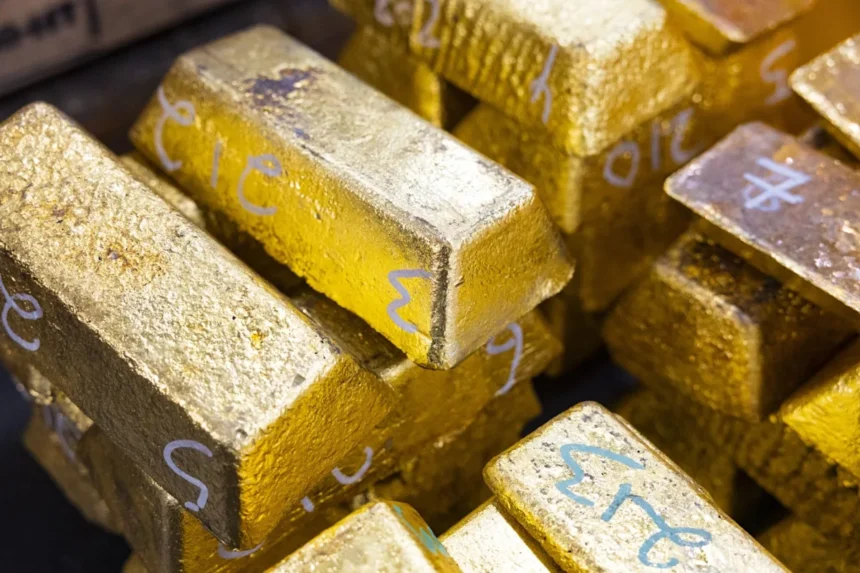
In a dramatic shift across financial markets, gold prices plummeted sharply, driven by a selloff that saw traders offloading metals to cover losses from falling equities. This trend extended to silver and copper, with significant declines reported across the board. The selloff was largely precipitated by renewed doubts regarding the viability of substantial investments in artificial intelligence, which weighed heavily on U.S. technology stocks and sparked a broader risk-off sentiment among investors.
Gold experienced a steep decline, plummeting as much as 4.1%, while silver faced an even sharper drop of 11%. Copper commodities on the London Metal Exchange also fell, declining by 2.9%. However, both gold and silver managed to recover some of their losses after the initial shock.
Market observers noted the rapidity of the decline, with Nicky Shiels from MKS PAMP SA describing it as a “risk-out” move typical during periods of heightened market stress. In such scenarios, even traditionally safe-haven assets like gold can be sold off as investors scramble for liquidity. Part of Thursday’s selloff was attributed to profit-taking, as the metals had recently surged due to speculative buying tendencies.
Ole Hansen, a commodity strategist at Saxo Bank, emphasized that day-to-day trading in gold and silver remains heavily influenced by market sentiment and momentum. Thus, during volatile market conditions, these metals can struggle to maintain their value.
Gold and silver have been on a volatile run since the beginning of 2024, with momentum-driven purchases helping to push prices to record highs last month. However, the momentum came to a sudden halt on January 29, marking one of gold’s most significant plummets in over ten years and silver’s largest historic drop. Since then, both metals have remained in a narrow trading range, marked by increased volatility amid a lack of new developments that could influence prices.
Market analyst Fawad Razaqzada from Forex.com remarked that Thursday’s decline should not be seen as an indicator of a sustained downward trend for gold. Instead, it highlights the potential for ongoing volatility in the near future. The recent market activity has cleared a substantial amount of downside liquidity, indicating that future price movements will be closely tied to how the metals behave around critical technical levels.
Bloomberg strategists noted that the AI-driven risk-off sentiment in equities has broadened, leading to a sudden decline in metals that appears to have stemmed from systematic selling strategies typical of momentum-driven traders. As metals faced significant pressure, a slight bounce in prices could not mask the overall downturn.
Despite the recent turbulence, several financial institutions are optimistic about gold’s future, citing factors such as ongoing geopolitical tensions, uncertainties regarding the Federal Reserve’s independence, and a shift away from conventional assets like currencies and sovereign bonds. JPMorgan Private Bank has projected that gold could reach between $6,000 and $6,300 an ounce by year-end, with both Deutsche Bank AG and Goldman Sachs Group Inc. maintaining bullish forecasts as well.
Traders are now closely monitoring U.S. economic indicators, particularly core consumer price figures due out on Friday, as these will provide insights into the Federal Reserve’s potential trajectory regarding interest rates. Lower borrowing costs typically enhance the appeal of precious metals, which do not yield interest payments.
As market activity unfolds, spot gold was recorded at a notable price in New York, while silver also saw a decline. Additionally, platinum and palladium prices fell, and the Bloomberg Dollar Spot Index—a measure of the U.S. currency—registered a slight uptick of 0.1%.