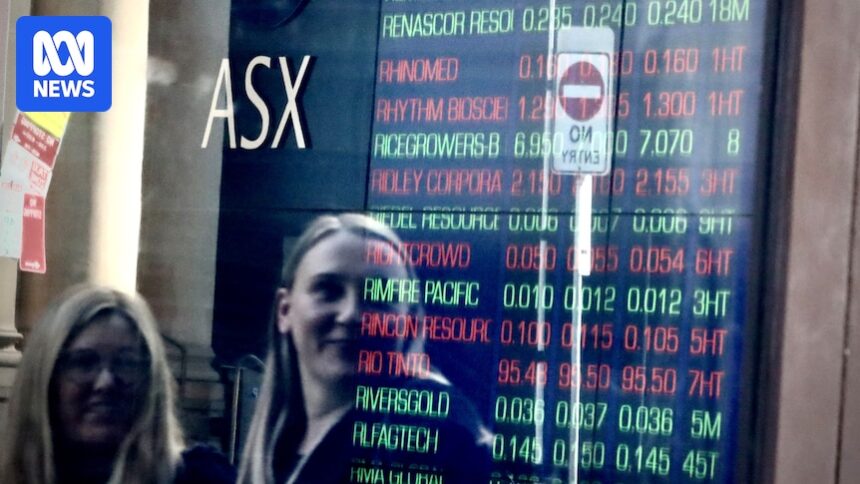
The Australian share market is experiencing notable declines today, with the S&P/ASX 200 index down 1.33%, settling at 8,923.2 points. This sell-off reflects concerns stemming from both local and international economic conditions, exacerbated by the looming Friday 13th superstition in the markets.
The broader atmosphere is underscored by negative trends from Wall Street, where the S&P 500 and the Nasdaq fell by 1.5% and 2.1% respectively, while European markets also displayed weakness with the EuroStoxx down 0.5% and the DAX remaining flat. Commodity markets are mixed, with spot gold showing a 1.2% increase to $4,978 per ounce, while Brent crude saw a minor drop, trading at $67.42 per barrel. The Australian dollar has slightly depreciated to 70.82 US cents.
A report from CreditorWatch outlines the challenges facing Australia’s retail sector, indicating that insolvencies have surged by approximately 50% compared to pre-COVID levels. These financial struggles are attributed to changing consumer behavior combined with persistent cost pressures. CEO Patrick Coghlan emphasized that the current retail environment signals a substantial structural reset rather than a transitory cycle.
The banking sector is also in focus, as recent adjustments to savings rates from the big four banks followed a decision by the Reserve Bank of Australia. However, Canstar reports that not all rates reflected the full 0.25 percentage point adjustment, potentially leaving many depositors short-changed. Westpac has emerged with the highest ongoing savings rate at 5.25%, although this applies only to a specific demographic, leaving many customers likely missing out.
Amid these tumultuous conditions, AMP’s chief economist Shane Oliver notes positive prospects for the Australian dollar, predicting it could climb further to around 73 US cents due to a depreciation in the US dollar and strong commodity prices.
On the stock front, significant declines are noted for Austal Limited, which saw a staggering drop of 22% after disclosing that it had misreported financials related to incentives for a US program. Similarly, Cochlear shares plummeted 17% following a disappointing earnings report that revealed a decline in sales revenue. Notably, Nick Scali, despite reporting a profit increase, saw its stock fall 17%, signaling broader market discontent with earnings that failed to meet investor expectations.
In governance, the newly elected Liberal leadership team, led by Angus Taylor and his deputy Jane Hume, has pledged to focus on economic issues, criticizing the current Labor government’s management. Hume highlighted the struggles of young Australians in an economic landscape shadowed by past recessions and a perceived inability to achieve financial stability.
Overall, as Australia’s financial markets navigate through these challenging conditions, the dual influences of local economic stresses and international market trends suggest that further volatility may be ahead in the coming weeks.