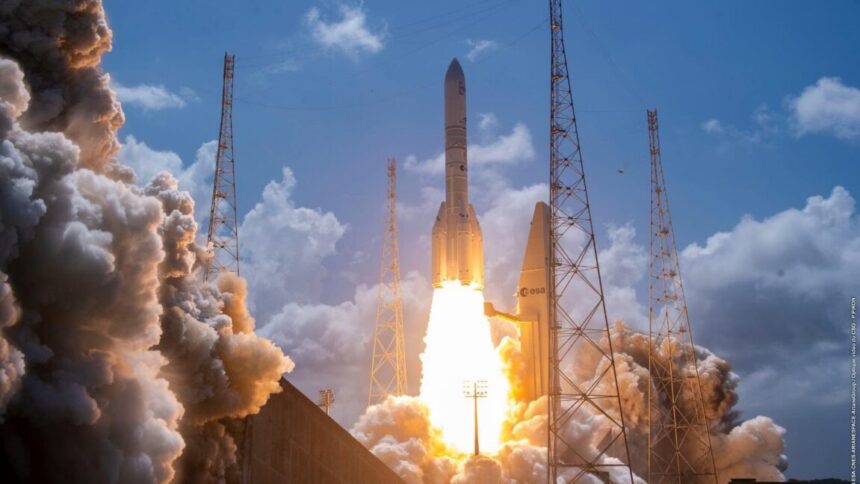
In a significant advancement for its satellite constellation, Amazon has successfully launched 32 Low Earth Orbit (Leo) satellites aboard an Ariane 64 rocket from French Guiana. This mission marked a crucial step in deploying Amazon’s ambitious fleet, which aims to consist of over 3,200 satellites designed to provide broadband services and compete with existing networks. The Ariane 64 was equipped with an extended payload shroud to accommodate the impressive payload, which weighed approximately 20 metric tons, nearing the rocket’s maximum lift capacity.
With this launch, Amazon has made considerable progress, having deployed a total of 214 production satellites through eight missions conducted by various launch providers, including United Launch Alliance (ULA), SpaceX, and now Arianespace. Online reports state that Amazon has strategically secured over 100 missions across four launch providers to ensure their satellite network’s comprehensive coverage.
This development places Amazon in direct competition with SpaceX’s Starlink, which currently has over 9,000 satellites in orbit and serves more than 9 million broadband subscribers. Interestingly, Amazon initially opted to work with other companies for its satellite launches, bypassing SpaceX when selecting partners for what was formerly known as Project Kuiper.
Amazon’s strategy involved booking nine launches on ULA’s soon-to-be-retired Atlas V rocket, with five already completed. The company has also reserved flights for its remaining satellite launches, opting for more innovative platforms. These include 38 flights on ULA’s new Vulcan rocket, 24 on Blue Origin’s New Glenn, and 18 on Europe’s Ariane 6, indicating a diversified approach to launch capabilities.
By contrast, the new rockets have encountered various delays but are now operational. The Ariane 6 has achieved the fastest launch cadence among the new entries, with six successful flights completed following the recent mission. Meanwhile, ULA’s Vulcan rocket has launched four times, although issues with one of its solid rocket boosters during a military mission early Thursday raised concerns about the reliability and timing of Amazon’s forthcoming launches on Vulcan.
On the horizon, Blue Origin, the space venture founded by Amazon’s Jeff Bezos, is preparing for the third launch of its heavy-lift New Glenn rocket, potentially occurring next month. However, there has yet to be an announcement regarding when the first set of Amazon Leo satellites will be launched aboard New Glenn, leaving stakeholders eager for further updates. This evolving landscape emphasizes the competitive dynamics of satellite internet deployment as companies strive to capture market share in the burgeoning sector.