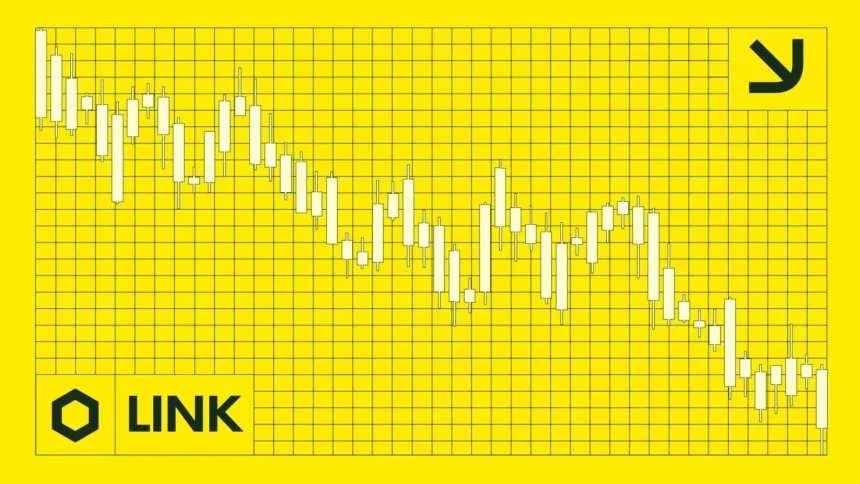
Chainlink’s recent market performance signals a concerning trend for investors, as the cryptocurrency’s price has plummeted to its lowest level in over two years, dropping below the significant $10 threshold for the first time since late 2023. Currently lingering near $8.25, Chainlink (LINK) has witnessed a dramatic decline of more than 40% from its January highs, with no immediate signs of recovery evident on the charts.
The breakdown below the $10 mark has exposed a critical psychological support level, previously a bastion for buyer confidence. This shift has occurred amid persistent macroeconomic pressure, particularly in anticipation of the latest Consumer Price Index (CPI) release. On-chain analysis supports this downturn, indicating a substantial increase in LINK’s inflows to exchanges, which surged to nearly 3.8 million tokens this week. This influx has created a pronounced sell-side pressure that has overwhelmed minimal inflows from exchange-traded funds (ETFs).
Data reveals that the total transfer volume of LINK to exchanges spiked significantly on February 5 and 6, with inflows surpassing 4.5 million and 5 million, respectively, suggesting a clear trend of higher inflows correlating with declining prices since late January. Following these peaks, inflows decreased sharply, with February 8 marking a particularly low day for transfers. Although LINK experienced slight price stabilization during this period, a resurgence in inflows from February 9 to 11 indicated ongoing selling pressure.
Despite the challenging price dynamics, Chainlink’s underlying fundamentals are notably strong, creating a paradox for long-term holders. Recently, the launch of CME LINK Futures on February 9 has opened doors for institutional investment, while advancements like Ondo Finance’s adoption of Chainlink for Real World Assets (RWA) pricing infrastructure and Robinhood’s partnership for its new Layer 2 network have bolstered its prospects. Additionally, the adoption of Cross-Chain Interoperability Protocol (CCIP) continues to expand.
However, these positive developments have yet to reflect in Chainlink’s price, illustrating a classic case of value-price divergence often witnessed during bear markets. Compounding this frustration, LINK’s weighted sentiment has seen a notable uptick, recently reaching high levels not seen since early 2026. Despite sentiment improvements, LINK’s price remains compressed around the $8.50 margin, illustrating a disconnect between optimism and market action. The negative sentiment plunge around February 5 coincided with the local price low near $8, but since then, there has been little movement upward, reflecting a fragile market structure.
Looking forward, Chainlink’s price trajectory appears bleak. The weekly chart indicates a maintained macro downtrend, currently positioned at approximately $8.40 after failing to hold above the crucial 0.236 Fibonacci level near $12.76. The rejection from the $25.47 region marked a significant lower high, and the price trajectory has closely followed a descending channel, characterized by a series of lower highs and lower lows. Recent movements toward the $8 area highlight continued structural weakness rather than a stabilization.
Chainlink is significantly trading below the 200-week Exponential Moving Average (EMA), situated around $13.85, which now acts as a form of dynamic resistance. Unless LINK can reclaim and sustain levels above this moving average on a weekly closing basis, any potential bounce would merely be a temporary relief within the broader bearish framework. The key horizontal support level looms at around $4.90, aligning with prior cycle lows, raising concerns about the cryptocurrency’s future stability.
As Chainlink’s price nears the lower boundary of the descending channel, a short-term bounce may occur from this zone. Nevertheless, unless a clear shift in momentum takes place, leading to a break in the pattern of lower highs, the prevailing bearish trend is likely to persist. Investors remain cautious, bracing for potential further declines.