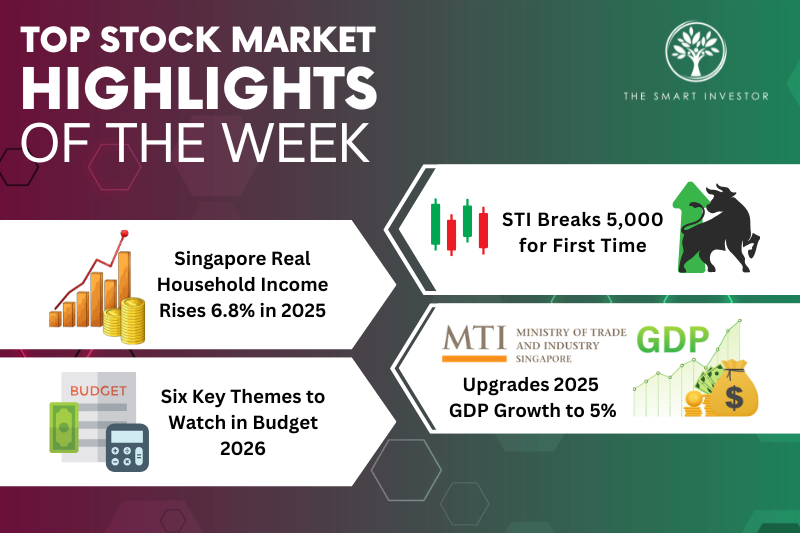
Singapore’s financial landscape witnessed a momentous occasion this week as the Straits Times Index (STI) surged past the 5,000-point threshold for the first time in its history. This remarkable achievement was recorded on 12 February 2026, with the index reaching 5,004.02 during morning trading. The escalation significantly outran analyst predictions and was primarily fueled by substantial gains among key blue-chip companies, particularly the three major local banks, which collectively represent approximately half of the index’s weight.
Investors observed notable performances from prominent banking institutions; DBS Group climbed 0.5% to S$57.77, OCBC Bank increased by 1.3% to S$21.62, and UOB saw a 0.9% rise, reaching S$39.23. This milestone follows an impressive 22.7% increase in the STI throughout 2025, reflecting the effectiveness of strategic initiatives designed to rejuvenate Singapore’s equity market. Among these initiatives, the Monetary Authority of Singapore’s S$5 billion Equity Market Development Programme and the proposed SGX-Nasdaq dual-listing framework stand out.
Analysts have grown increasingly optimistic about the STI’s trajectory, with JP Morgan projecting that the index could ascend to as much as 6,500 points by the end of the year.
In tandem with this stock market breakthrough, new data released by the Department of Statistics (SingStat) revealed a significant rise in Singapore’s median household market income, climbing by 6.8% in real terms for 2025. This data marks an important shift, as it utilizes an expanded definition of “market income,” including non-employment sources such as rental income and CPF payouts. Consequently, median monthly household market income rose to S$12,446, reflecting a 7.7% increase in nominal terms. Additionally, income per household member surged by 8.4% nominally to S$4,160.
The growth in average monthly income was observed across all income deciles, with lower-income households experiencing notably higher growth rates. Employment sources constituted 79.6% of total household market income, although this percentage revealed a slight decline from 81.1% in 2024. Encouragingly, income inequality has also diminished, with the Gini coefficient reducing to 0.452 from 0.46 in the previous year.
On 10 February 2026, the Ministry of Trade and Industry (MTI) adjusted the GDP growth forecast for 2025 upwards to 5.0%, surpassing the initial estimate of 4.8% and exceeding prior official projections of “around 4%.” The fourth quarter recorded a robust growth adjustment to 6.9% year-on-year, driven by a thriving manufacturing sector and strength in finance and insurance. The demand for artificial intelligence bolstered performance in the electronics and machinery sectors, while finance and insurance experienced widespread growth.
For 2026, the MTI has revised its GDP growth forecast to between 2% and 4%, a change prompted by an improved global economic outlook and sustained investments in AI. Many economists have subsequently raised their 2026 projections, ranging from 2.8% to 3.6%. This enhanced outlook heightens expectations regarding potential monetary policy adjustments, with speculation that the Monetary Authority of Singapore may tighten its monetary stance in upcoming months.
Prime Minister Lawrence Wong presented Budget 2026 on the same day that the STI broke the 5,000-point barrier, emphasizing artificial intelligence as a cornerstone of Singapore’s economic future. Under his leadership, a new National AI Council will spearhead AI initiatives, and the “Champions of AI” program aims to foster comprehensive business transformation through AI innovations. Furthermore, the Enterprise Innovation Scheme will be expanded to incorporate AI investments, and Singaporeans enrolled in select AI courses will gain six months of complimentary access to advanced AI tools.
Additional support measures announced include funding for small and medium enterprises to drive internationalization, alongside a S$1 billion injection into the startup ecosystem and a S$1.5 billion allocation for an Anchor Fund. New options for CPF members include a voluntary life-cycle investment scheme offering potentially enhanced returns for individuals with longer investment horizons.
In the wake of increasing vehicle taxes intended to encourage electric vehicle adoption, Wong also indicated that the carbon tax might stabilize between S$50 to S$80 per tonne by 2030, contingent on global climate trends.