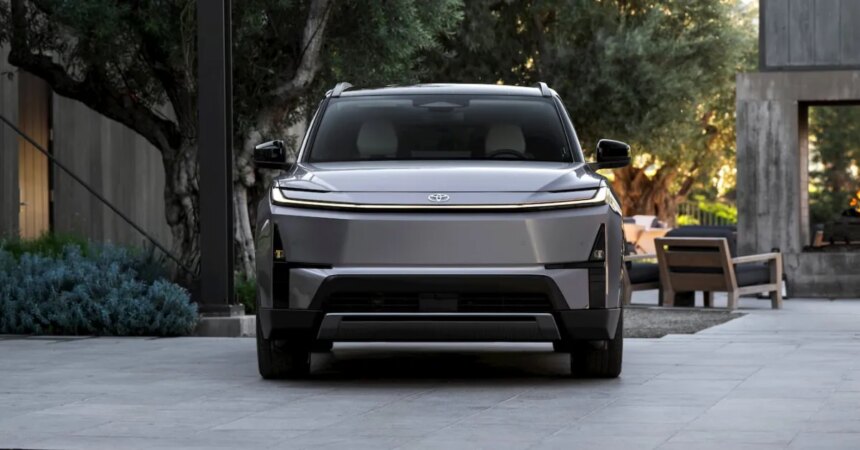
Toyota is gearing up for a significant expansion in its electric vehicle (EV) offerings with the impending arrival of the Highlander EV later this year. This new model marks an essential addition to Toyota’s strategy to secure a stronger position in the rapidly growing electric SUV market.
The introduction of the Highlander EV signals Toyota’s commitment to diversifying its lineup, transitioning from a multi-pathway approach that includes battery-electric vehicles (BEV), hybrid (HEV), plug-in hybrid (PHEV), and fuel-cell electric vehicles (FCEV). With the unveiling of the 2027 Highlander BEV, the company has acknowledged a clearer direction: it will exclusively offer electric SUVs, thus addressing a notable gap in its range.
Amid recent reports of declining EV sales, largely attributed to the expiration of the $7,500 federal tax credit at the end of September, Toyota remains optimistic. David Christ, Vice President of Toyota Motor North America, expressed confidence in the market viability of the Highlander EV, stating that it is not merely a niche product but one likely to generate significant sales volume.
This confidence comes at a pivotal moment for the automotive industry, as competition in the electric SUV segment intensifies. Notably, Ford has withdrawn plans for a three-row electric SUV scheduled for 2024, while Tesla plans to cease production of the Model X by the end of the second quarter next year. This shake-up presents an opportunity for Toyota to capture market share.
Reflecting on the competitive landscape, Christ remarked that while other mass-market brands have consistently outpaced Toyota in EV sales, the company recognizes the necessity of expanding its electric vehicle options. “We think we felt one of our portfolio holes was not having EV options in the showroom,” he noted.
The Highlander is just one of four new electric SUVs Toyota plans to release by the end of 2026, joining the newly opened orders for the 2026 bZ, C-HR, and bZ Woodland. Despite the downward trend in EV sales, Christ asserts that Toyota is poised to claim its rightful share of the market, with these new models expected to boost sales.
One of the standout features of the upcoming lineup is the updated 2026 bZ, which has garnered attention for rectifying issues found in the earlier bZ4X model. Enhancements include a 25% increase in driving range—now reaching up to 314 miles—alongside a revamped interior and exterior design, plus the addition of a North American Charging Standard (NACS) port to enable charging at Tesla Superchargers across the U.S.
These improvements appear to resonate with consumers, as the new bZ has been among the top-selling EVs in the U.S. recently, outperforming competitors such as the Hyundai IONIQ 5 and Ford Mustang Mach-E. Brand loyalty may also play a critical role in bolstering Toyota’s performance in this segment. According to the JD Power 2025 U.S. Automotive Brand Loyalty Study, Toyota has maintained a 62% loyalty rate, the highest among mass-market brands.
Pricing for the upcoming models reflects Toyota’s strategy to appeal to a broad consumer base. The 2026 bZ starts at under $35,000, while the C-HR will be priced around $37,000 with standard all-wheel drive. The Highlander EV is anticipated to have a price range of $50,000 to $55,000, positioning it similarly to other competitors like the Kia EV9.
To make their new electric SUVs even more enticing, Toyota is rolling out promotional offers, including a $5,000 customer cash bonus and 0% financing. As these models hit the dealerships, it remains to be seen how they will resonate with consumers in the evolving EV market.