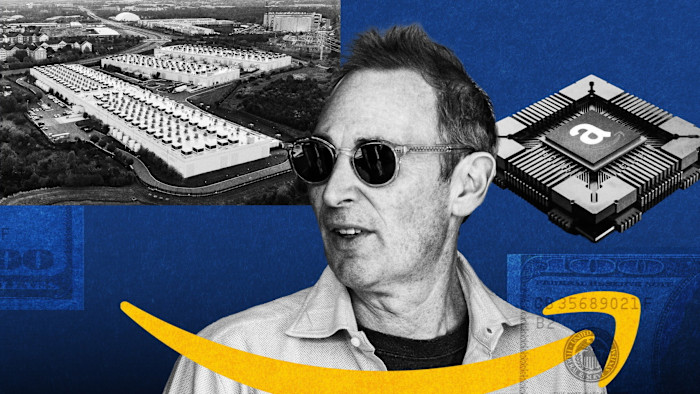
Amazon is set to initiate the most significant capital expenditure program in its history, aiming to bolster its position against rivals in the artificial intelligence (AI) sector. This initiative comes as the company undergoes a strategic transformation, driven by concerns that its cloud services division, Amazon Web Services (AWS), is falling behind competitors in the highly competitive AI landscape. This situation has been echoed by insights from multiple current and former senior employees.
CEO Andy Jassy recently disclosed plans to increase Amazon’s capital expenditure to $200 billion this year, surpassing the growth of similar investments by tech giants like Google and Microsoft. The focus of this hefty investment will be on enhancing computing infrastructure and expanding data centers, as well as developing specialized chips for AI models. Moreover, Jassy has unified the company’s chip and advanced research teams under a single leadership structure, a maneuver intended to streamline Amazon’s AI strategies, highlighted by significant job cuts totaling around 30,000 roles from its corporate workforce of approximately 350,000.
“We have deep experience understanding demand signals in the AWS business and are turning that capacity into a strong return on invested capital,” Jassy remarked earlier. This confidence is juxtaposed with concerns within AWS that the company has not fully capitalized on its leading position in cloud computing, specifically noting a sluggish pace in securing major contracts with AI providers following the launch of OpenAI’s ChatGPT in 2022. As one former senior AWS employee articulated, “We were just not fully prepared for how fast things would unfold.”
AWS continues to hold its position as the leading cloud provider globally, recording nearly $130 billion in sales over the past year, accounting for more than 60% of Amazon’s overall profits. Still, analysts predict a shift where demand for AI-driven cloud services could enable Microsoft to surpass AWS in the coming three years. In response, Amazon maintains that other providers do not report accurate cloud figures, complicating comparisons between the cloud service businesses.
Out of Amazon’s ambitious $200 billion capital expenditure plan, approximately 75% is earmarked for AWS, according to public filings. In stark contrast, Microsoft, Google, and Oracle are on track to collectively invest around $400 billion this year. While Jassy stated that Amazon aims to significantly expand its data center capacity this year—having already increased it by nearly 4 gigawatts in 2025—there are mixed feelings among investors. Shares of Amazon have fallen over 20% since their peak in November, raising concerns about the pace at which these expenditures will yield returns.
Amid these strategic shifts, AWS is under pressure to secure more contracts with prominent AI firms, which are critical drivers of new cloud business. Amazon has invested $8 billion in Anthropic while developing data centers specifically for the company, although this investment came after Google initially backed the startup. Additionally, while Amazon signed a $38 billion cloud computing deal with OpenAI, this pales in comparison to Microsoft’s $250 billion contract with the AI maker and Oracle’s $300 billion in deals.
Despite these challenges, Amazon asserts that AWS is successfully capturing a significant share of large enterprise and government transitions to cloud services. The company has also highlighted sales growth of its custom chips, Graviton and Trainium, which are designed for various cloud applications and AI training, and it anticipates combined annual revenue surpassing $10 billion from these products.
While Amazon pushes to fortify its AI offerings, it faces challenges as some industry experts express skepticism about the likelihood of leading AI startups adopting its chips, even if they present a more cost-effective solution than Nvidia’s offerings. Amazon has been working on its own “Nova” AI models, branded as a low-cost alternative to competing offerings; however, independent benchmarks indicate that Nova does not measure up to the top-tier models from rival companies like OpenAI and Google.
While internal pressures mount to advance AI technologies, some employees express concerns about falling behind in the innovative landscape. Reports emerge of a cultural shift within the company, rekindling fears of a decline described by founder Jeff Bezos as “day two”—a state of stasis that precedes a painful decline. As one senior AWS engineer noted, “The culture has shifted, but so has the world around us. We’re going to have to prove our worth.”