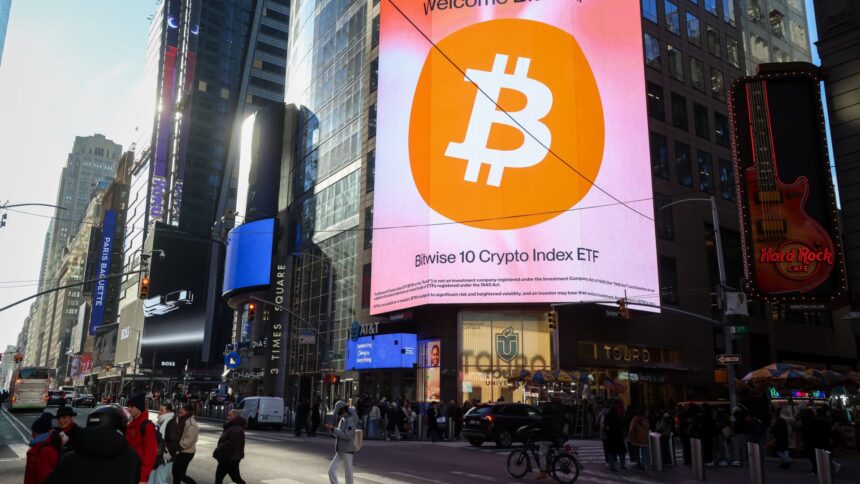
Bitcoin’s significant decline from its all-time high of over $126,000 last October has cast a shadow over the entire cryptocurrency market. Once viewed as a robust alternative to gold—a trusted store of value—Bitcoin is now losing its luster, particularly amid concerns about a potential prolonged downturn reminiscent of the catastrophic period following the FTX collapse in 2022, when Bitcoin’s price plummeted from nearly $50,000 to around $15,000. So far, Bitcoin has seen a nearly 50% drop in value since that peak, with over a 25% slump occurring in just the past month alone.
Despite these unsettling trends, cryptocurrency investing experts speaking on CNBC’s “ETF Edge” remain cautiously optimistic about the long-term outlook. Recent fund flows into and out of Bitcoin and crypto exchange-traded funds (ETFs) indicate that long-term investors are not entirely fleeing the asset class. While there has been a notable capital outflow—approximately $2.8 billion in net outflows from the iShares Bitcoin Trust (IBIT) over the past three months—this figure is counterbalanced by significant inflows into ETFs over the past year, with near $21 billion moving into BlackRock’s ETF alone, according to VettaFi statistics.
The spot Bitcoin ETF category has demonstrated a similar divergence in asset flows, experiencing around $5.8 billion in net outflows in recent months but still maintaining a positive net inflow of $14.2 billion over the year. Experts suggest that the bulk of the outflows may not reflect panic among long-term investors. Matt Hougan, the Chief Investment Officer of Bitwise Asset Management, explained that the selling pressure appears to be driven mostly by crypto investors who have held positions for a considerable time and are now trimming their exposure. He noted that hedge funds and short-term traders often utilize liquid ETFs and are prone to pulling capital quickly when market conditions turn unfavorable.
At a recent CNBC Digital Finance Forum, Galaxy CEO Mike Novogratz described the prevailing market climate as an end to the “era of speculation,” predicting that future returns in the crypto space will resemble more traditional long-term investments. He emphasized that retail investors are often drawn to cryptocurrency for high returns, not for modest yields.
Meanwhile, financial advisors at major Wall Street banks are increasingly incorporating Bitcoin into diversified investment portfolios, creating custom-branded crypto ETFs to cater to client demand. Some longer-term investors view the current volatility as a temporary phase, willing to weather the downturn rather than sell off their assets rapidly. If there were widespread capitulation across the board, experts argue, the outflows would likely mirror the scale of inflows seen in prior months.
Nevertheless, the ongoing downturn is difficult for many Bitcoin investors to endure. Will Rhind, founder and CEO of GraniteShares, expressed concern about the current market conditions. He highlighted that the rising prices of other “hard” assets, like gold, have only compounded Bitcoin’s issues. Investors who have aligned Bitcoin with the concept of “digital gold” are feeling particularly disillusioned, as the price decline comes alongside gold reaching all-time highs. Rhind remarked, “This is not supposed to happen,” emphasizing that a situation where Bitcoin suffers such significant losses while traditional safe-haven assets thrive is troubling for those who believed in its reliability.
As Bitcoin continues to navigate this turbulent period, the overall sentiment in the cryptocurrency space remains complex and multifaceted, highlighting the challenging landscape for investors.