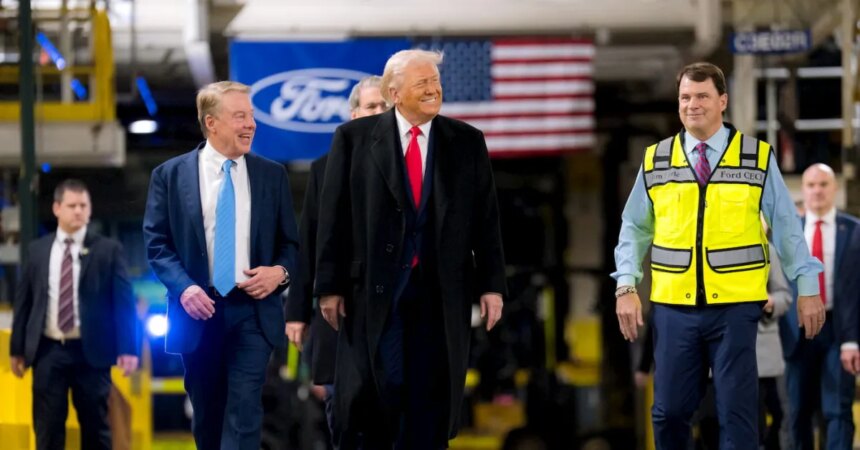
In a significant development for the automotive industry, Ford’s CEO, Jim Farley, has engaged in discussions with the Trump Administration regarding a potential partnership between U.S. automakers and Chinese electric vehicle (EV) manufacturers. This initiative could lead to groundbreaking collaborations aimed at building electric vehicles within the United States.
China has emerged as the world’s largest market for electric vehicles, registering nearly 3 million battery electric vehicles (BEVs) in the fourth quarter of 2025, marking a 16% increase year-over-year and propelling global EV sales to over 4 million units for the first time. This impressive growth has prompted major global automotive brands, including Ford, to explore opportunities in collaboration with China’s leading EV manufacturers.
While the U.S. government has traditionally imposed significant tariffs and restrictions on Chinese automakers, a shift toward allowing partnerships may be on the horizon. Sources familiar with the matter revealed that Farley proposed the idea of joint ventures with Chinese brands to senior officials in the Trump administration, including U.S. Trade Representative Jamieson Greer, Transportation Secretary Sean Duffy, and EPA Administrator Lee Zeldin at last month’s Detroit Auto Show.
The suggested collaborations would permit Chinese companies to manufacture vehicles in the U.S. through alliances with domestic brands. Although these discussions are still in their preliminary stages, they could revolve around technology sharing and profit agreements.
Trump himself has recently signaled a willingness to reconsider the barriers against Chinese brands, suggesting that, if allowed to enter the market, these companies would need to establish plants in the U.S. and hire American workers. This contrasts sharply with previous stances taken during his presidency. However, not all automakers are on board with this approach; General Motors has voiced strong opposition, warning that such moves might undermine U.S. market share and severely impact the North American supply chain.
The potential for these partnerships would dramatically alter the landscape of the U.S. automobile industry. Discussions about these collaborations come in the wake of Canada’s recent deal with China that has drastically reduced tariffs on EV imports, which has generally garnered public support for making EVs more affordable.
Furthermore, Ford has reportedly been in talks with several prominent Chinese EV manufacturers, including BYD and Geely. Collaborating with BYD could facilitate battery procurement for hybrid vehicles to be sold outside the U.S. Meanwhile, a partnership with Geely could allow for the use of underutilized manufacturing facilities in Europe, enabling a joint technological exchange.
Despite the potential benefits, numerous U.S. officials remain wary, citing security concerns. Secretary Duffy expressed doubts regarding Canada’s recent deal with China, suggesting it may be a misstep.
Ford has made strides in its own EV production, including plans to produce lower-cost lithium iron phosphate (LFP) batteries utilizing licensed technology from Contemporary Amperex Technology Co Limited. These batteries are set to support the company’s Universal EV platform, starting with affordable models targeting a price point around $30,000 starting in 2027.
However, the global landscape is changing, with companies like BYD surpassing Ford in total vehicle sales recently, underscoring the competitive pressure U.S. automakers are facing. As electric vehicle demand surges, the urgency for U.S. brands to forge partnerships to maintain competitiveness has never been more pressing.
In light of these shifting dynamics, the question remains: will the U.S. regulatory environment evolve to accommodate these potentially transformative partnerships with Chinese EV manufacturers? The answer could significantly shape the future of the American automotive industry amidst a broader global shift toward electrification.