The electric vehicle (EV) industry is facing significant challenges as the new year begins, with many manufacturers struggling to adapt to the recent elimination of federal tax credits for new EV purchases. Since the credits were abolished at the end of September, companies have been compelled to reduce prices significantly to offset the effects of the lost subsidies. Nonetheless, this strategy has not yielded the desired results; recent data reported by the Wall Street Journal indicates that EV sales plummeted by over 30% in the fourth quarter of 2025, with early indicators suggesting an even steeper decline in January.
Amid this tumultuous landscape, major players in the industry have reacted decisively. Ford incurred a staggering $19.5 billion in expenses in December alone due to the ongoing downturn. Meanwhile, Stellantis, the parent company of Jeep, has taken an even more drastic step, announcing $26 billion in special charges linked to its scaled-back electrification plans just ten days ago. This widespread retraction underscores the severity of the current market conditions for EV producers.
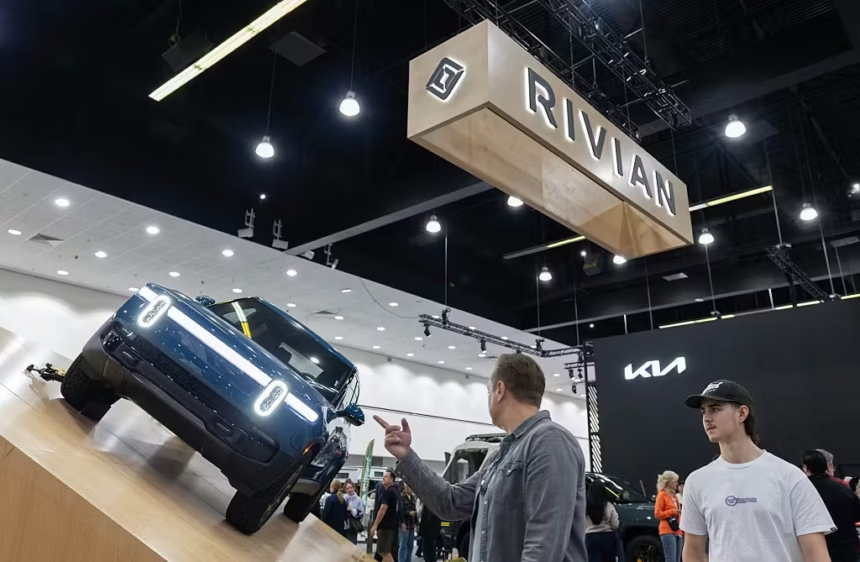
Interestingly, amidst the backdrop of widespread financial troubles, electric vehicle manufacturer Rivian experienced a notable surge, achieving its best day on the stock market to date with a more than 25% jump this past Friday. Despite the excitement surrounding this leap, Rivian continues to operate with a significant cash burn rate in its primary business of vehicle sales. The company suffers an average loss of approximately $10,200 for each vehicle sold.
However, Rivian’s software business has emerged as a bright spot, contributing substantially to its financial health. Last year, this division generated approximately $576 million in gross profit, allowing the company to post a positive overall gross profit of $144 million—an impressive $1.34 billion improvement compared to figures from 2024. The positive financial outlook for Rivian, along with a forecast of delivering between 62,000 and 67,000 vehicles in 2026, played a pivotal role in fueling its stock’s recent surge.
Despite this remarkable one-day increase, analysts remind us that Rivian’s current market valuation is still substantially lower than its peak—a time when expectations for electric vehicles were soaring following its IPO in 2021. Even after the recent boost, the company’s market cap stands at roughly one-seventh of what it was at its height, illustrating the ongoing volatility and uncertainty in the EV market. As the industry continues to grapple with these challenges, the long-term implications for both established producers and emerging players like Rivian remain to be seen.