In April 2025, amid significant turmoil on U.S. stock markets following Donald Trump’s controversial “Liberation Day” decisions, Peter Navarro, an influential adviser on tariffs, made an audacious prediction: he asserted that the Dow Jones Industrial Average would not only recover, but also exceed 50,000 points. At that moment, skepticism was widespread, yet events unfolded that proved Navarro’s assertions to be eerily prescient.
On February 6, 2026, the Dow indeed crossed the historic threshold of 50,000 points for the first time. This milestone was accompanied by a broader uptick in stock markets, with the S&P 500 and Nasdaq also recording gains exceeding 10% over the preceding year. This development brings some relief to the 62% of American adults who are invested in the stock market.
Critics often reiterate that the stock market does not equate to the overall health of the economy, a statement grounded in both truth and misconception. While it is valid that not every economic indicator moves in tandem with stock prices, the divergence misses the connection that stock performance often reflects the financial viability of companies employing the majority of American workers.
Recent economic data reveals robust indicators: over 75% of S&P 500 firms experienced year-on-year earnings growth in the fourth quarter of 2025, marking the highest level of earnings growth recorded in four years. This data corresponds with a stable job market; the Bureau of Labor Statistics reported a significant spring in January employment numbers, with 130,000 new jobs created and a resulting drop in the unemployment rate to 4.3%.
Furthermore, inflation rates are showing signs of improvement, presenting the lowest figures since 2021. Data on real incomes suggests positive growth; average weekly earnings adjusted for inflation rose by 1.9% from January 2025 to January 2026. Reports indicate that life has become generally more affordable for Americans compared to the previous year, contrary to prevailing narratives suggesting widespread economic hardship.
Despite some criticisms claiming that wealth concentration is unfavorable and detrimental to the average citizen, reports from economists indicate a more balanced wealth distribution. The chief U.S. economist at Barclays emphasized that wealth accumulation has occurred across various socio-economic brackets rather than being a phenomenon limited to the upper class.
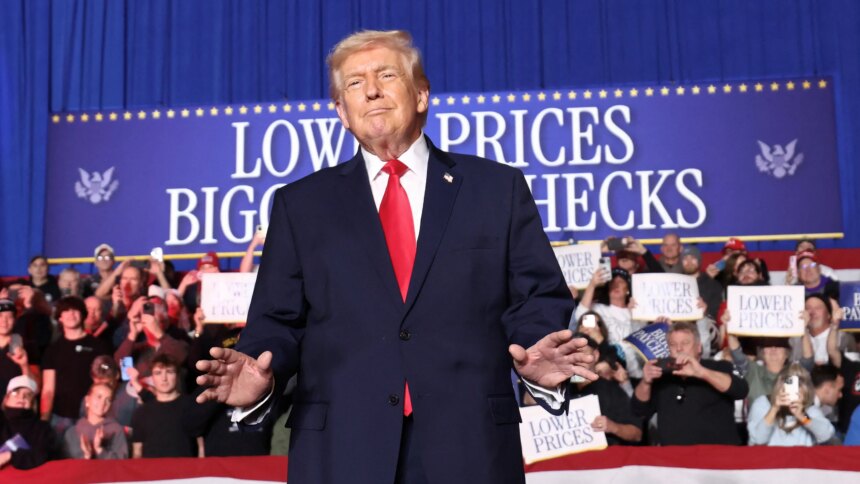
Despite these positive trends, a paradox arises: why do many Americans harbor skepticism about the economy’s strength? A significant portion of the blame rests on Trump himself, who tends to oversell economic achievements. Upon the Dow reaching 50,000, he boldly predicted that the index would hit 100,000 before the end of his term. His inconsistent tariff policies add layers of uncertainty that create hesitation within the business community.
Partisanship further complicates perceptions of the economic landscape. A recent Gallup poll showcased a stark divergence in opinions: 82% of Republicans held an optimistic view of future economic growth compared to only 24% of Democrats. Discrepancies also surfaced in predictions regarding stocks, interest rates, unemployment, and inflation.
This contrasting atmosphere has led to the emergence of the term “vibecession,” coined by writer Kyla Scanlon in 2022 to describe the disconnect between emotional perceptions of the economy and the actual financial metrics. This phenomenon illustrates how emotions can often distort one’s understanding of economic realities, which are significantly influenced by tangible measures such as bank balances and stock portfolios.
The current economic situation is reminiscent of various historical contexts, drawing comparisons to Bill Clinton’s presidency, which, despite significant economic strength, also faced criticism. Notably, during Clinton’s second term, unemployment and cumulative inflation rates exceeded those during Trump’s first term.
As opinions continue to polarize, it is crucial to disentangle emotional responses from factual assessments of the economy. Regardless of any political sentiments, the present data suggest the U.S. economy is navigating a resilient path, countering narratives that portray it as struggling.