Amazon has recently discontinued the Blue Jay warehouse robot, introduced just a few months earlier in October. This decision came to light in January, highlighting the complexities involved in developing practical and cost-effective AI robotics technology. Industry insiders shared that many employees involved in the Blue Jay project have since been transitioned to other robotics initiatives within Amazon.
The closure of Blue Jay underscores the challenges of applying AI in the physical realm, where obtaining useful training data is significantly more complex than in the digital sector. An Amazon spokesperson, Terrence Clark, confirmed that although Blue Jay is being discontinued, its core technology will be integrated into future projects within the company’s network of warehouses. He noted that the discontinuation is part of Amazon’s broader strategy in warehouse robotics, which includes programs such as Vulcan, Sparrow, and Proteus.
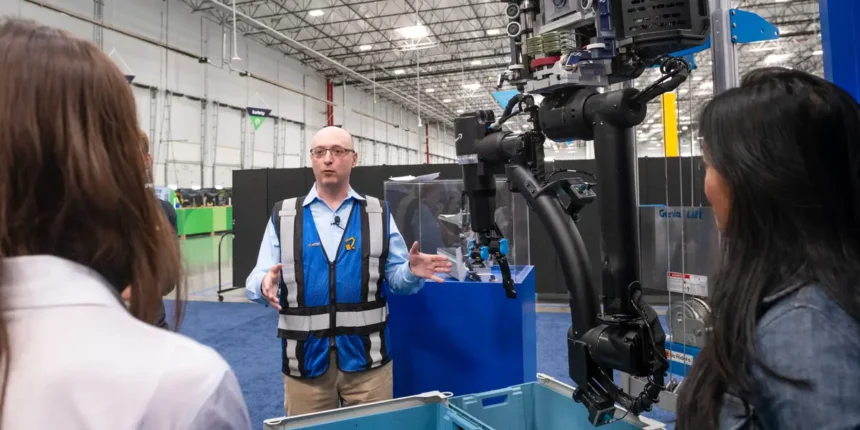
When Amazon debuted Blue Jay, it was hailed as a major advancement, developed in just over a year compared to its predecessors like Robin or Sparrow. With multiple arms capable of reaching and lifting several items simultaneously, the design aimed to enhance productivity and ensure a safer work environment for employees. Initially piloted in a fulfillment center in South Carolina, it was seen as a crucial technology for advancing same-day delivery while reducing operational costs.
Nonetheless, internal challenges emerged regarding Blue Jay, particularly concerning its high cost, manufacturing complexity, and implementation difficulties, leading to its eventual suspension. Although the system itself is being shelved, Amazon plans to integrate aspects of its technology into a forthcoming system called “Flex Cell,” which will adopt a more floor-mounted design rather than the ceiling-mounted structure of Blue Jay.
In a notable shift, Amazon is pivoting away from its previously utilized same-day warehouse system, referred to internally as the “Local Vending Machine” (LVM). LVM facilities were characterized by their large, monolithic structure with tightly integrated automation. In contrast, the new “Orbital” system is designed to be modular, allowing for various components that can be arranged in different configurations. This flexibility is expected to facilitate easier deployment and scalability, particularly for smaller same-day delivery warehouses.
There are also implications for grocery delivery, as the Orbital system is anticipated to handle chilled products, such as those sold at Whole Foods. The enhanced modularity aims to revamp Amazon’s same-day delivery capabilities, especially in competition with Walmart in the grocery sector. However, the rollout of the Orbital system is not expected until 2027, according to knowledgeable sources.
Overall, Amazon’s ongoing experimentation with warehouse robotics reflects both the potential for innovation and the significant hurdles that remain in marrying AI technology with real-world applications.