Asian markets experienced a notable uptick on Thursday, buoyed by a rally on Wall Street primarily led by Nvidia, a powerhouse in the computer chip industry. While U.S. futures showed a slight downturn, oil prices increased amid escalating tensions regarding potential conflict with Iran.
Reports indicate that U.S. President Donald Trump is contemplating military action against Iran, as his administration amplifies military presence in the region and engages in indirect discussions over Iran’s nuclear program. Such developments have raised concerns that a military strike could trigger broader conflict in the Middle East.
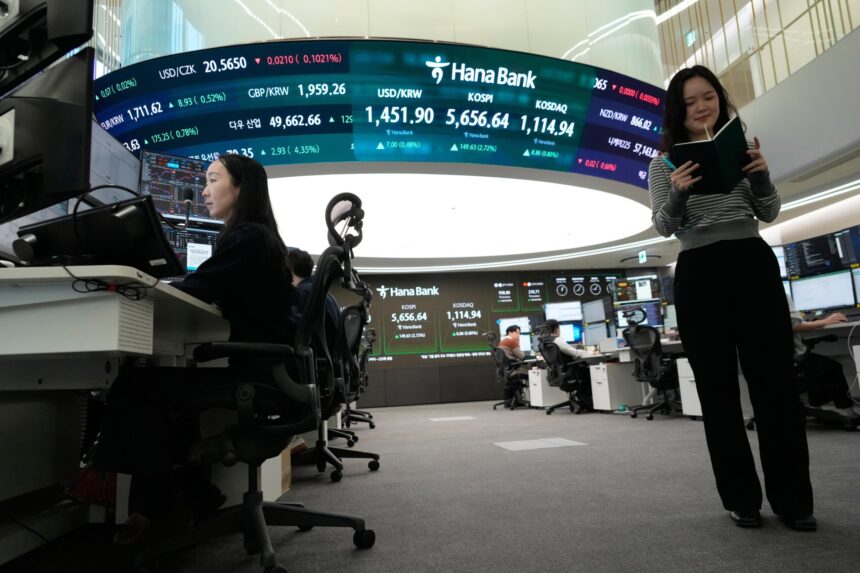
Markets in Greater China were closed for the Lunar New Year, while other regions reopened for trading. In Japan, the Nikkei 225 posted a gain of 0.8%, closing at 57,582.93. South Korea’s Kospi saw a robust surge of 2.8%, settling at 5,661.22, as it resumed trading after recent holidays. The Australian S&P/ASX 200 climbed by 0.9%, reaching 9,088.70, while Southeast Asian markets also reflected bullish trends; Thailand’s SET index rose by 0.9%, and India’s Sensex edged up by 0.1%.
European markets exhibited positive movement as well, with London’s FTSE 100 rising by 1.2%, fueled by a recent inflation update that bolstered predictions of impending interest rate cuts by the Bank of England.
On Wall Street, the S&P 500 increased by 0.6% to 6,881.31, while the Dow Jones Industrial Average gained 0.3%, reaching 49,662.66. The Nasdaq composite rose by 0.8%, closing at 22,753.63. Nvidia played a significant role in this market performance, gaining 1.6% following news of a long-term partnership with Meta Platforms, which will utilize millions of Nvidia chips for its artificial intelligence data centers. Nvidia’s CEO, Jensen Huang, emphasized the scale at which AI is being deployed at Meta, reinforcing the company’s valuation as the most significant on Wall Street.
This surge showcased the potential benefits of AI development; however, investors remain vigilant about the possible risks associated with widespread AI adoption. Concerns have emerged that if AI tools efficiently execute complex tasks at lower costs, several sectors such as software, legal services, and logistics may face significant competitive threats. This has led to erratic market behavior, with investors reacting swiftly—often with a “shoot first—ask questions later” approach to market threats.
Stock performance on Wednesday was aided by several promising corporate earnings reports, reinforcing a robust reporting season for major U.S. firms within the S&P 500. Notably, Moderna’s shares jumped by 6.1% after the FDA announced it would review the company’s flu vaccine candidate, which had been previously dismissed.
In the bond market, Treasury yields saw a marginal increase, following the release of unexpectedly positive economic data. The yield on the 10-year Treasury bond rose to 4.08% from 4.05%. Reports indicated stronger-than-expected industrial production and an uptick in orders for various manufactured goods excluding transportation equipment, as well as an increase in new home construction permits.
Such encouraging data raises the possibility of the Federal Reserve maintaining steady interest rates, as officials at the Fed have expressed a preference for observing a further decline in inflation before considering additional rate cuts this year. While the Fed has paused its rate cuts, forecasts among Wall Street analysts suggest potential reductions may occur later in the year, especially following the anticipated transition of leadership within the Fed.
In early Thursday trading, U.S. benchmark crude oil prices climbed by 30 cents to $65.36 per barrel, while Brent crude increased by 27 cents to $70.62. Gold and silver prices remained stable, while Bitcoin prices saw a minor decline of 1.3%, settling around $67,000.