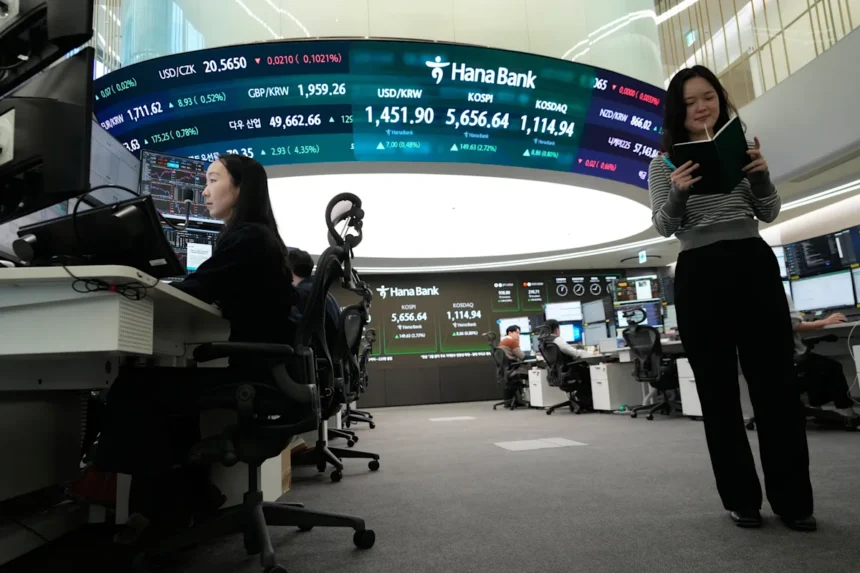
Asian shares experienced a mostly positive trajectory on Thursday, buoyed by a strong rally on Wall Street, notably driven by the computer chip giant Nvidia. In the U.S., futures showed a slight decline while oil prices rose amid escalating tensions regarding potential conflict with Iran. Reports indicated that U.S. President Donald Trump is contemplating military action against Iran, as his administration sends more military resources to the region and engages in indirect talks concerning Iran’s nuclear program. This situation has sparked concerns that any military confrontation could lead to a broader conflict in the Middle East.
While markets in Greater China remained shut for the Lunar New Year holidays, other regional markets resumed trading. In Tokyo, the Nikkei 225 index increased by 0.6%, ending at 57,467.83. South Korea’s Kospi surged by 3.1% to reach 5,677.25, rebounding after earlier holidays, with Samsung Electronics, the market leader, climbing 4.9%. Meanwhile, Australia’s S&P/ASX 200 index advanced 0.9% to 9,086.20. Southeast Asian markets also reported significant gains, with Thailand’s SET index up by 1.7%, although India’s Sensex lost early momentum, declining by 0.8%.
In Europe, Wednesday trading saw London’s FTSE 100 rise by 1.2%, partly spurred by new data on U.K. inflation that suggested a potential interest rate cut by the Bank of England may be on the horizon. Wall Street’s performance mirrored this trend— the S&P 500 rose by 0.6%, the Dow Jones Industrial Average added 0.3%, and the Nasdaq composite gained 0.8%.
The upward movement in the U.S. market can be significantly attributed to Nvidia’s stock, which rose 1.6% following a long-term partnership announcement with Meta Platforms. This partnership will see Meta utilize millions of Nvidia chips and equipment for its artificial intelligence data centers. Nvidia’s CEO, Jensen Huang, emphasized the scale at which Meta deploys AI, highlighting the company’s pivotal role in the tech sector. However, while Nvidia’s performance has showcased the positive aspects of AI for the stock market, investors have recently become wary of the potential negative impacts that AI advancements could have on various industries—including software, legal services, and logistics—prompting some aggressive selling of stocks perceived to be at risk.
Several corporate earnings reports contributed to the market rally on Wednesday, continuing a promising trend in the reporting season for major U.S. companies within the S&P 500. Notably, Moderna’s stock surged by 6.1% after receiving news that regulators from the Food and Drug Administration would review its flu vaccine candidate, which had previously been denied consideration.
Economic forecasts also exceeded expectations, with reports indicating improved industrial production and a rise in orders for durable goods, excluding volatile categories like transportation equipment. Additionally, new home construction figures surpassed predictions, suggesting a resilient housing market. This strong economic data may encourage the Federal Reserve to maintain stable interest rates for the time being, although many market analysts anticipate rate cuts could resume later this year, potentially during the summer, particularly with a new chair set to take over.
Minutes released from the Fed’s last meeting indicated that many officials are inclined to await further declines in inflation before supporting additional rate cuts, which could help stimulate economic growth but potentially exacerbate inflationary pressures simultaneously.
In early trading on Thursday, U.S. benchmark crude oil saw a modest increase of 20 cents, landing at $65.25 per barrel, while Brent crude gained 15 cents, trading at $70.50. The dollar purchased 155.09 Japanese yen, an increase from 154.83, and the euro rose to $1.1796 from $1.1782. Additionally, gold prices climbed by 0.5% and silver by 1.5%, although Bitcoin’s value fell by 1.4%, settling at approximately $67,000.