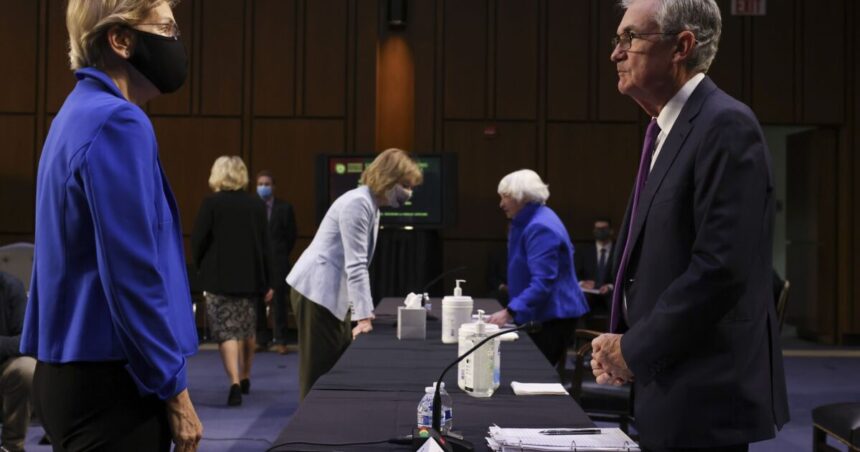
Senate Banking Committee ranking member Elizabeth Warren, D-Mass., has issued a stern warning to top federal regulators regarding potential bailouts for the cryptocurrency industry in light of significant declines in asset values. In a recent letter to Treasury Secretary Scott Bessent and Federal Reserve Chair Jerome Powell, Warren expressed her concerns and urged them to commit to avoiding any intervention that could resemble a bailout for the struggling crypto market.
Warren’s call to action comes as Bitcoin, the leading cryptocurrency, has seen its value plummet nearly 50% since October, dropping from over $120,000 to just above $66,000. This sharp correction, which Warren attributes to a shift in investor sentiment away from speculative assets, poses a substantial threat not only to Bitcoin but also to the wider cryptocurrency ecosystem, as Bitcoin constitutes approximately 60% of the market capitalization.
In her correspondence, Warren highlighted the implications of a potential bailout, arguing that any government intervention would effectively transfer taxpayer dollars to already wealthy crypto interests. She pointed out that significant stakeholders in the cryptocurrency realm, including former President Donald Trump, who has ties to the crypto industry through his family’s World Liberty Financial firm, could benefit from federal assistance.
Warren emphasized the urgent need for stronger consumer protections, urging policymakers to prioritize bolstering safeguards for individual crypto investors instead of propping up wealthy industry players. “American taxpayers should not be on the hook for billionaire crypto investors,” she declared.
Recent developments have added weight to Warren’s arguments. As corporate holders of Bitcoin experience stock declines, it has become increasingly clear that prominent investors are suffering substantial losses. Reports indicate that figures such as Binance founder Changpeng Zhao and Coinbase CEO Brian Armstrong have each incurred billions in losses, further underscoring the significant financial blows being dealt to the industry.
The Massachusetts senator expressed her concern over the broader powers held by the Treasury and the Federal Reserve, particularly in providing liquidity through mechanisms like the Exchange Stabilization Fund and the Fed’s emergency 13(3) lending facilities. At a recent hearing, Warren pushed Bessent for clarity on the government’s stance regarding potential crypto bailouts, but the response left her uneasy. Instead of providing a definitive “no,” Bessent deflected the question, stating the government was “retaining seized bitcoin,” which raised questions about the administration’s plans for any potential intervention.
In light of these developments, Warren urged that government measures should focus on regulation rather than providing guarantees or liquidity support for troubled cryptocurrency firms. She cited the growing prevalence of scams, noting that over $17 billion has reportedly been lost or stolen due to crypto-related fraud. A recent report from Chainalysis pointed out a sharp increase in fraud connected to Bitcoin ATMs, with scammers having stolen over $333.5 million from Americans using these kiosks between January and November 2025.
Warren’s letter underscores an ongoing debate in Washington about the appropriate response to the volatile cryptocurrency market, as well as the broader implications for consumer protection and financial regulation in the digital age. As the landscape continues to evolve, Warren’s push for heightened regulatory measures reflects an attempt to safeguard everyday investors and ensure that taxpayers are not unduly burdened by the risks associated with cryptocurrency investments.