In a significant display of ambition and networking, rapper Nicki Minaj, FIFA president Gianni Infantino, and Goldman Sachs CEO David Solomon gathered at Donald Trump’s Mar-a-Lago resort in southern Florida this week. This event marked the inaugural conference for World Liberty Financial (WLF), a cryptocurrency venture closely linked to the Trump family, aiming to showcase its capabilities as a burgeoning player in the global finance sector nearly a year and a half ahead of the 2024 elections.
The summit, hosted by Trump’s sons—Donald Trump Jr., Eric Trump, and Zach and Alex Witkoff—brought together around 400 dignitaries, including two U.S. senators, hedge fund manager Philippe Laffont, Franklin Templeton CEO Jenny Johnson, and Changpeng Zhao, the billionaire founder of Binance, who received a pardon from Trump last year.
Eric Trump proclaimed from the stage, “This is retribution,” as attendees gathered in the lavish ballroom adorned with a sculpture of WLF’s eagle logo. He elaborated on how the company was born from adversity, stating, “When we lost the ability to bank, we created World Liberty Financial.” Donald Trump Jr. echoed this sentiment, asserting, “Some of Wall Street’s biggest lenders wanted us to crawl into the corner and die. They created a monster.”
Despite WLF’s relatively modest market capitalization of $5 billion compared to its competitors—Tether and Circle, valued at $185 billion and $73 billion respectively—the company’s influence is amplified by its association with the Trump brand. The family has dabbled in various crypto ventures, including a “memecoin” launched by Donald Trump before his inauguration and another coin introduced by Melania Trump shortly thereafter.
Earlier this month, WLF disclosed a $500 million investment backed by an Abu Dhabi royal just days before Trump’s inauguration, denying any links to agreements on U.S. AI chip access for the UAE. Though Trump himself was absent from the conference, his presence lingered throughout the resort, which prominently features the Trump name across decor and merchandise available for purchase.
During lunch, which included assorted meats and shrimp cocktail, discussions shifted focus toward the impact of artificial intelligence on U.S. capital markets and rising interest in event contracts related to sports and politics. Commodity Futures Trading Commission chair Michael Selig highlighted prediction markets as a “check on our news media,” while other speakers, including Senator Bernie Moreno, criticized the current administration.
The topic of crypto legislation surfaced frequently throughout the event. Coinbase CEO Brian Armstrong, present at the conference, found himself at the center of discourse regarding the Clarity Act, which has been a point of contention as traditional banks push back against the growing reach of crypto entities. Goldman Sachs’ David Solomon framed the conversation as a call for equitable treatment between established financial institutions and emerging crypto players.
WLF’s leadership has ambitious plans, including an application for a U.S. banking license designed to deepen its integration into the traditional financial system. Co-founder Zak Folkman mentioned futuristic aspirations for the platform, such as allowing retail traders to use “tokenized luxury floating villas in the Maldives” as loan collateral or employing AI agents to manage investments on behalf of users.
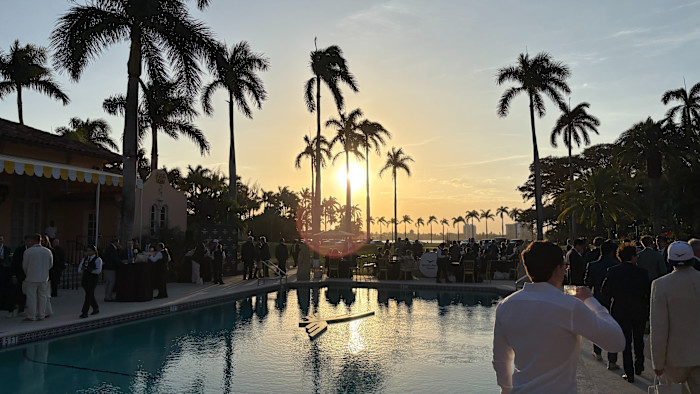
As discussions drew to a close and guests mingled at the poolside reception, an overwhelming consensus emerged among attendees that WLF was poised to carve out a significant role in the future of finance. The sentiment encapsulated a belief in the company’s mission to build a robust infrastructure for the next generation of financial systems, signaling a new chapter in the intersection of cryptocurrency and traditional banking.