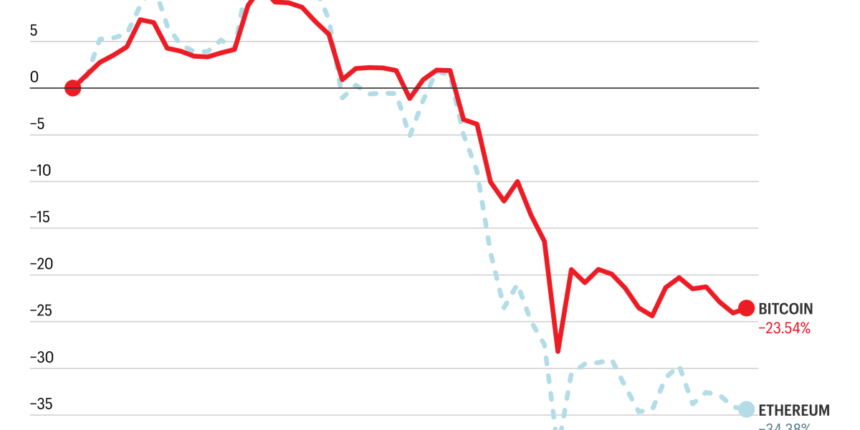
Despite experiencing slight gains on Friday, the world’s two leading cryptocurrencies are registering historically poor performances this year. Bitcoin has seen a nearly 24% decline since January 1, trading around $67,000, while Ethereum has plunged about 34%, now valued at approximately $2,000. This marks the worst year-to-date performance on record for both cryptocurrencies, as analyzed by Fortune using CoinGecko’s publicly available data.
Historically, the value of cryptocurrencies has often mirrored trends in the broader equities market. However, this year, a notable divergence has emerged. While cryptocurrencies struggle, equity markets are making modest gains. The S&P 500 index has risen approximately 0.4%, and the Dow Jones Industrial Average has seen a 2.3% increase over the same period. Even precious metals like gold and silver have shown strong performances, with gold appreciating around 17% and silver around 14% since the start of the year.
As the crypto market continues to deviate from these broader economic trends, many industry observers suggest that the sector may be entering a new “Crypto Winter.” This term is used to describe a period of prolonged downturns in the market, despite Bitcoin achieving all-time highs just four months ago. Danny Nelson, a research analyst at Bitwise, expressed his views, stating, “We’re certainly in a Crypto Winter. You can tell by how investors react to good news. (They don’t.)”
The drastic declines in the prices of Bitcoin and Ethereum can be traced back to a sharp market correction known as a “flash crash” that occurred on October 10. During this event, traders witnessed the loss of more than $19 billion in leveraged positions following renewed tariff threats from President Donald Trump against China. CoinGlass reported this crash to be the worst liquidation event documented in the crypto market.
Since that date, Bitcoin has dropped over 46%, resulting in disappointing financial results for major crypto exchanges like Coinbase and Gemini for their fourth quarters. Some traders are facing substantial losses, leading to significant actions such as BlockFills, a crypto lender and hedge fund, suspending customer withdrawals earlier this month. Reports indicate that the firm is now actively seeking a buyer after incurring losses exceeding $75 million.
The ongoing decline has left many stakeholders puzzled, given the absence of a clear catalyst for this downturn. Previous bear markets were often triggered by specific events, such as the collapse of the FTX exchange in November 2022. Conversely, this current slide comes amid a backdrop of increasing regulatory acceptance of cryptocurrencies and growing interest from institutional investors.
Despite the bearish sentiment, some analysts remain optimistic about the future of the industry. Nelson remarked on the evolving landscape, stating, “Crypto’s reality is getting stronger. These changes are going to last well beyond the current downturn.” Similarly, Tom Lee, cofounder of the analysis firm Fundstrat, expressed a positive outlook, noting, “We’re really close to the end” of this difficult period.