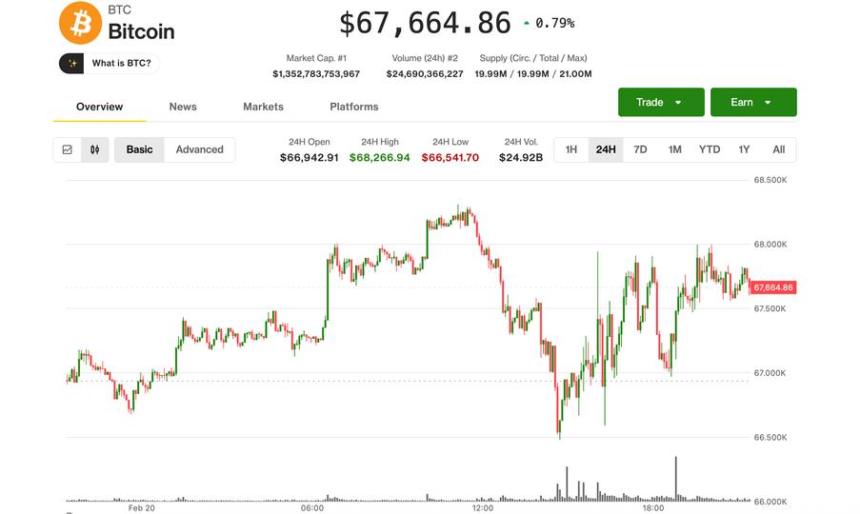
Bitcoin, currently trading at approximately $67,931.96, showed resilience amid fluctuating U.S. tariff news on Friday, inching closer to the $68,000 mark while altcoins experienced modest gains. The morning commenced with a notable ruling from the U.S. Supreme Court, declaring President Donald Trump’s global tariff implementation illegal. The decision left unanswered questions surrounding the fate of the revenues already collected through these tariffs and did not impose definitive limits on Trump’s ongoing trade agenda, which could still pursue various legal and executive paths.
By the afternoon, President Trump announced a new 10% global tariff to be implemented under Section 122, set to take effect in three days and lasting roughly five months. Despite the imposition of this additional tariff, market sentiment remained largely unshaken, with risk assets, including cryptocurrencies, gradually trending upward throughout the session. The broad-market CoinDesk 20 Index rose by 2.5% over the previous 24 hours, with notable gains among altcoins such as BNB, DOGE, ADA, and Solana, each registering advances of 3%-4%. Bitcoin itself was trading just under $68,000.
On the traditional equity front, major indices also enjoyed positive momentum, with the S&P 500 and Nasdaq 100 increasing by 0.9% and 0.7%, respectively. Among stocks closely tied to the cryptocurrency sector, firms like Coinbase, stablecoin issuer Circle, and Bitcoin treasury firm Strategy saw their shares rise by over 2%. Conversely, Bitcoin miners linked to artificial intelligence infrastructure faced setbacks, with stocks such as Riot Platforms, Cipher Mining, IREN, and TeraWulf witnessing declines of 3% to 6%.
Market analysts suggest that while a rally appears to be unfolding for risk assets in response to the tariff developments, there is a prevailing caution about any breakout in prices. Paul Howard, director at trading firm Wincent, noted, “Volumes, however, remain muted, and we can expect crypto to maintain range bound trading for the time being,” unless there are significant macroeconomic or geopolitical shocks. A critical potential macro risk on the horizon is the possibility of President Trump ordering military strikes against Iran, given the marked military buildup in the region over recent weeks.