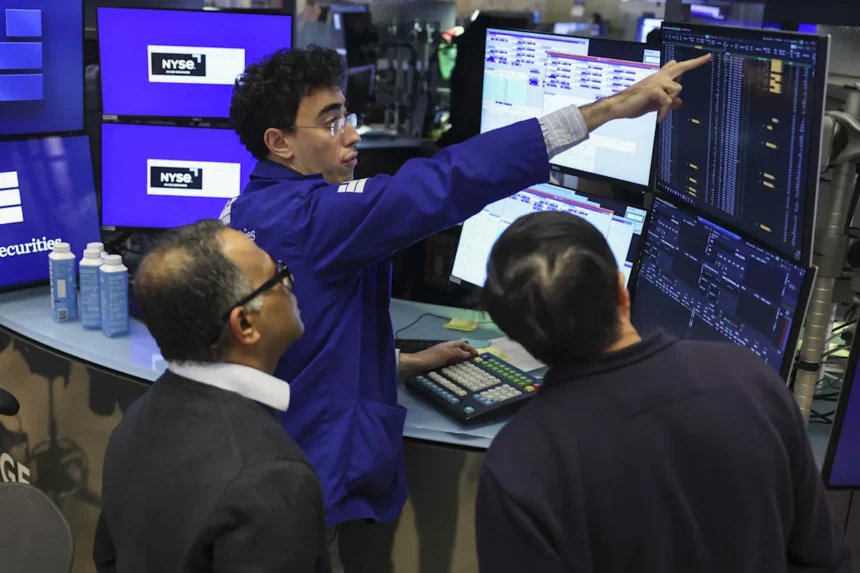
Stock futures remain steady this morning as investors prepare for crucial economic indicators to conclude the holiday-shortened trading week. The forthcoming reports on fourth-quarter gross domestic product (GDP) and the Federal Reserve’s favored inflation measure, the Personal Consumption Expenditures (PCE) index, are generating anticipation. Recently, futures linked to the Dow Jones Industrial Average, S&P 500, and Nasdaq each registered a slight decline of 0.1%. The major indexes experienced a setback on Thursday, interrupting a three-day winning streak for both the Dow and S&P 500.
In commodities, crude oil futures dipped by 0.5%, maintaining a price above $66 a barrel. This follows the commodity reaching its highest price in six months as tensions rise over the U.S. moving military assets to the Middle East while engaged in negotiations with Iran regarding its nuclear program. Meanwhile, gold futures saw an increase of nearly 1%, reaching around $5,040 an ounce. The yield on the 10-year Treasury, which influences various consumer borrowing rates, decreased to 4.06%, down from 4.08% in the previous session. Bitcoin remained stable, hovering around $68,000.
Analysts are particularly focused on today’s economic data, with GDP figures and PCE inflation stats scheduled for release at 8:30 a.m. ET. Expectations suggest that GDP will register a growth rate of 2.5% for the fourth quarter, a decline from 4.4% in the third quarter, as the economy contended with the impacts of a record government shutdown in late 2023. The PCE inflation index is anticipated to show a year-over-year price increase of 2.8% for December, consistent with November’s results, while the core PCE, which excludes volatile food and energy prices, is projected to slightly increase to 3.0% from 2.8% in November. Both figures remain significantly above the Federal Reserve’s target inflation rate of 2%.
In the private credit sector, concerns are escalating after Blue Owl Capital announced the liquidation of $1.4 billion in assets to accommodate investors seeking to exit some of its private credit funds. These funds typically provide loans to businesses struggling to secure financing elsewhere, yielding high interest returns for investors. The rising trend of retail investors, who generally exhibit more risk aversion than their wealthier counterparts, has led to an increased demand for cashing out. This situation has raised questions about the stability of the private credit market, a sentiment echoed by industry leaders, including JPMorgan Chase CEO Jamie Dimon. Following the announcement, Blue Owl’s stock fell by 3% in premarket trading after a substantial 6% decline on Thursday.
Conversely, shares of Opendoor Technologies experienced a significant surge after the online real estate platform reported fourth-quarter revenues greatly exceeding analyst expectations. The company disclosed revenues of $736 million, accompanied by a smaller-than-anticipated adjusted loss. Opendoor reported a 46% increase in home purchases compared to the previous quarter and noted a 23% reduction in the average duration homes remain in its inventory. While it anticipates a 10% revenue decline in the first quarter compared to the previous quarter, Opendoor is optimistic about achieving adjusted profits by year-end, leading to an 18% rise in its stock before market open.
Applovin Corp. shares are also seeing an uptick amid rumors that the mobile advertising technology firm is planning to create its own social media network. Applovin previously vied for TikTok’s U.S. operations and has now posted a job listing for a software engineer to develop the foundation for a next-generation social platform. An executive recently discussed these ambitions on a Chinese-language podcast, expressing that Applovin’s existing monetization technologies distinguish it from companies like Meta Platforms, which built its social network without an initial monetization strategy. Applovin shares rose by more than 4% in current trading.