In a landscape where many automakers are struggling, Tesla continues to assert its leadership in the electric vehicle (EV) market. Contrary to popular belief, the company is not retreating from its core focus on EVs, but rather doubling down on its long-standing vision, which many of its competitors initially shared.
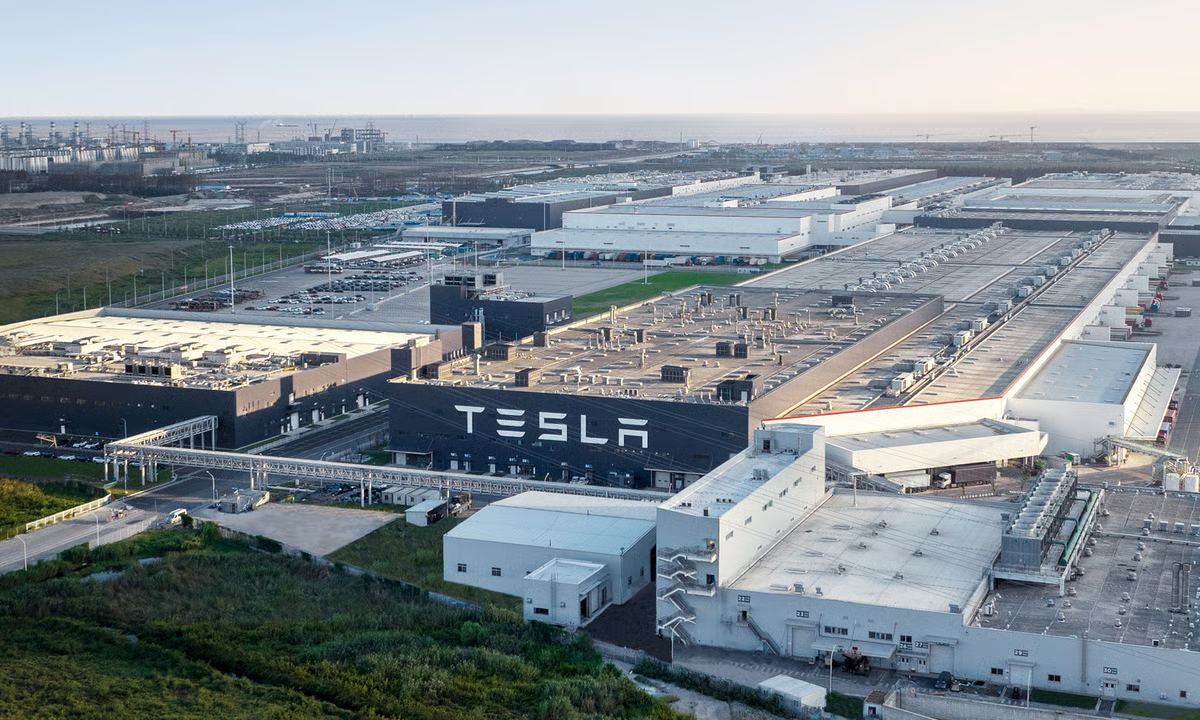
Recently, Tesla has committed to an ambitious $20 billion capital spending program. This extensive investment will enhance several critical aspects of its operations, including a lithium refinery in Corpus Christi, Texas, and a lithium iron phosphate (LFP) battery factory in Sparks, Nevada. Additionally, the Gigafactory in Texas is set to start production of the Cybercab, Tesla’s forthcoming robotaxi. These initiatives reflect Tesla’s unwavering commitment to supporting its vision for the future of electric mobility.
Some analysts have speculated that CEO Elon Musk’s recent focus on developing robotaxis and Optimus robots signifies a shift away from EVs due to declining sales. However, this interpretation overlooks the strategic investments Tesla is making to bolster its position in the EV market. As Tesla engages in this large-scale development, the legacy automakers are reassessing their own commitments to robotaxi technology, following more cautious and ultimately disappointing approaches in the past.
In 2019, Ford’s CEO Jim Farley projected a commercial self-driving service by 2021, only to pivot away from that ambition by 2022. Similarly, General Motors has struggled, previously pursuing robotaxi development but recently abandoning these plans altogether as of late 2024. The monumental costs involved in developing robotaxis highlight the perceived transformative potential of EVs—leveraging their lower per-mile operating costs through extensive usage.
Interestingly, the setbacks faced by traditional automakers in the EV sector have led to write-downs reaching billions. Ford reported losses of $19.5 billion, GM incurred $6 billion, and Stellantis faced $27 billion in losses as these companies grappled with their electric strategies. While GM managed to capture about 13% of the U.S. EV market compared to Tesla’s commanding 46% share, its foothold might waver as it recalibrates its approach.
As legacy automakers pivot to produce more targeted, affordable EV models—aiming to salvage their position in a tumultuous market—Tesla’s roadmap diverges. The company is not merely introducing lower-cost iterations of the Model Y and Model 3 while discontinuing the luxury Model S and Model X; instead, it is boldly focusing on the growth of its robotaxi business, with strong emphasis on the Cybercab.
While Tesla’s future is not guaranteed, its enduring alignment with its mission in the EV field stands in stark contrast to the struggles of its competitors. The company’s strategy not only underscores its belief in the viability of electric mobility but also reflects the ambitions many legacy carmakers once held but could not realize.