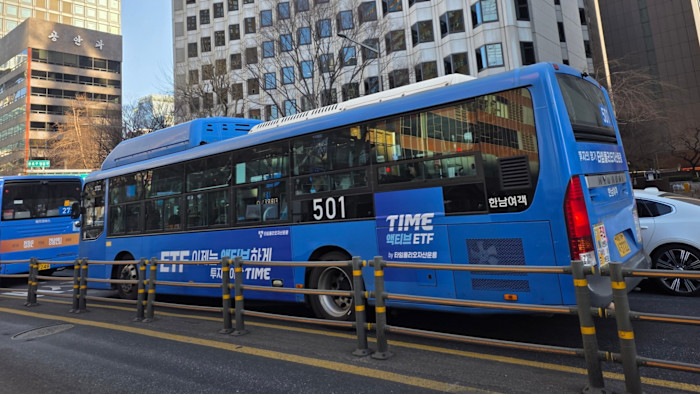
In the vibrant streets of Seoul, advertisements for exchange traded funds (ETFs) have become commonplace, urging citizens to invest their retirement savings into these intricate and often speculative financial products. The surge in interest comes on the heels of a remarkable 76 percent rally in the Korean stock market last year, with retail investors—often referred to as “ants”—keenly entering the market once again as it continues to show upward momentum this year.
Driven by the fear of missing out, these retail traders have shown a particular enthusiasm for leveraged ETFs, which magnify asset price movements and can lead to substantial profits or devastating losses. Analysts like Jongmin Shim, an equity strategist at CLSA, caution that many retail investors may not fully comprehend the risks associated with such investments. “The market has become speculative,” he noted, highlighting how performance-oriented retail traders are gravitating towards leveraged products without adequate risk management.
Government officials, however, maintain confidence in retail investors’ understanding of these products, claiming familiarity gained from trading on international markets like the US and Hong Kong. Data from the Korea Exchange indicates that retail investors have net purchased around Won6.3 trillion (approximately $4.3 billion) in locally listed stocks since the beginning of 2026 and directed an impressive Won13 trillion into Korean ETFs. This influx has significantly boosted the benchmark Kospi index by 35 percent this year, establishing it as one of the best-performing stock markets globally for two consecutive years.
Though leveraged ETFs represent a modest 3.7 percent of total assets held in Korean ETFs, they account for nearly 20 percent of all ETF trading volume on the Korea Exchange this year. Albert Yong from Petra Capital Management believes that government behavior has played a crucial role in catalyzing this ETF frenzy, with officials urging citizens to relocate their investments from foreign exchanges back to domestic stocks, especially as real estate prices have escalated beyond many people’s reach.
Reflecting this instructions, the government has also announced plans to approve leveraged single-stock ETFs that will track major blue-chip companies, including Samsung and SK Hynix, thereby expanding the range of investment options available to retail traders. This strategy seems to be paying off; for instance, Park Sun-hong, a 45-year-old businessman, shared his enthusiasm for ETFs, revealing that he had shifted a significant portion of his US-based investments back to a Kodex Leverage ETF that mirrors the Kospi index, citing its performance had exceeded his expectations.
Shim noted a burgeoning trend towards stock trading instead of property investment: “My father recently attempted to sell a house, but no one wanted to buy, as all available capital was invested in stocks.” The number of active individual stock trading accounts in Korea has surpassed 100 million, equal to nearly two accounts for every citizen. Meanwhile, deposits at retail brokerages designated for stock purchases reached an all-time high of Won103 trillion, up from Won87 trillion at the end of last year, with margin balances also surging to record levels.
The government’s recent initiatives, including tax breaks for those selling overseas stocks to invest domestically, are part of a larger strategy to improve corporate governance and enhance investment appeal in Korea’s stock market. President Lee Jae Myung has focused on reforms aimed at addressing the comparatively low valuations of Korean stocks while encouraging public investment in equities.
Despite the government’s proactive stances, financial experts like ChaiWon Lee from Life Asset Management argue that the heightened interest in Korean stocks is fueled as much by external factors, such as the “semiconductor supercycle” and global liquidity, as it is by domestic policy. He concluded that one of the primary drivers behind the retail shift is that the current climate in Korea’s stock market is significantly more favorable compared to the US.