U.S. futures experienced a downturn, while Asian markets generally saw an upward trend on Monday, following a significant Supreme Court decision that nullified most of President Donald Trump’s expansive tariffs. In the cryptocurrency sector, Bitcoin plummeted nearly 5%, falling below $65,000. This decline is attributed to investor withdrawals from speculative assets amid rising apprehensions regarding future regulatory frameworks for cryptocurrencies. Bitcoin, often referred to as “digital gold,” has witnessed a dramatic decrease in value, nearly halving since its peak of $126,210.50 on October 6.
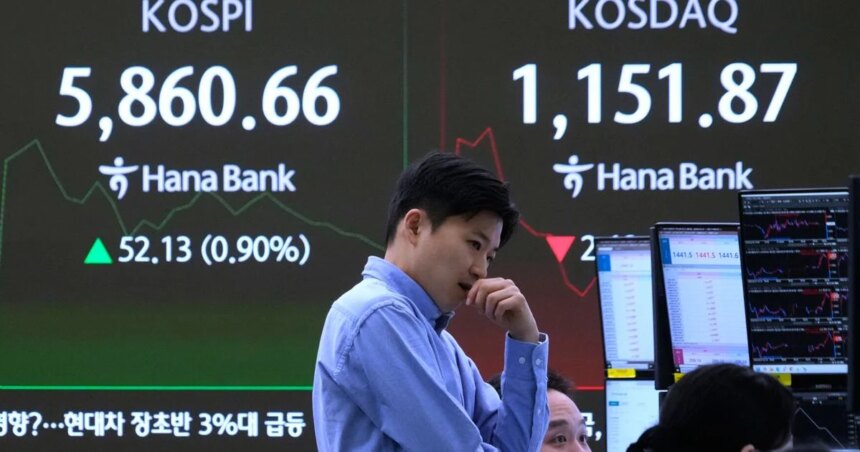
Asian markets reacted variably, with Japan and mainland China closed for public holidays. Hong Kong’s Hang Seng index led the positive momentum, soaring 2.2% to reach 26,980.22. Conversely, South Korea’s Kospi index slipped 0.1% to 5,809.53, while Australia’s S&P/ASX 200 fell 0.6% to 9,024.40. However, Taiwan’s Taiex gained 0.5%, and India’s Sensex rose by 0.4%. The Stock Exchange of Thailand (SET) also reported a 1.1% increase.
Market analyst Benjamin Picton of Rabobank commented on the mixed market responses, indicating that the recent shift in tariff policy has disproportionately benefited countries that previously faced unfavorable trade conditions. He emphasized that ongoing uncertainties regarding U.S. tariff policy would continue to create volatility as traders assess the implications of these changes.
In the futures market, the S&P 500 lost 0.8%, while futures for the Dow Jones Industrial Average and the Nasdaq composite index dropped by 0.7% and 1%, respectively. Despite initial reactions, Wall Street remained largely stable following the Supreme Court’s ruling, which had previously instigated significant market panic when the tariffs were first introduced last year. On Friday, the S&P 500 increased by 0.7% to 6,909.51, fluctuating between gains and losses ahead of the court’s decision, alongside disappointing reports showcasing a slowdown in U.S. economic growth coupled with rising inflation rates. The Dow added 0.5% to reach 49,625.97, while the Nasdaq composite grew 0.9% to 22,886.07.
Despite the Supreme Court’s ruling, Trump expressed intentions to levy new tariffs on imports using different mechanisms. He indicated plans to issue an executive order imposing a 10% global tariff, which was later increased to 15%. Trump mentioned investigating other tariff options that would necessitate inquiries by the Commerce Department, which contributed to the market’s cautious sentiments.
In corporate news, Akamai Technologies suffered a substantial 14.1% loss, one of the worst on the market, despite reporting better-than-expected results for the end of 2025. However, the company’s profit forecast for the following year fell short of analysts’ expectations, prompting concerns about its growth and spending on revenue-related investments, highlighting the impact of supply shortages in computer memory driven by the AI boom.
Concerning economic indicators, recent reports detailing sluggish growth and surging inflation elicited a muted response from markets. These conditions pose a dilemma for the Federal Reserve regarding interest rate adjustments, although traders remain optimistic, expecting at least two rate cuts this year. Lower interest rates would generally stimulate economic activity and boost investment prices, although they raise concerns about exacerbating inflation.
In commodity markets, early trading saw U.S. benchmark crude oil prices dip by 77 cents to $65.71 per barrel. Similarly, Brent crude fell by 74 cents to $70.56 per barrel. The U.S. dollar weakened against the Japanese yen, moving from 154.94 to 154.40 yen, while the euro appreciated to $1.1820 from $1.1797. Gold prices rose by 1.9%, and silver saw a significant increase of 5.4%.