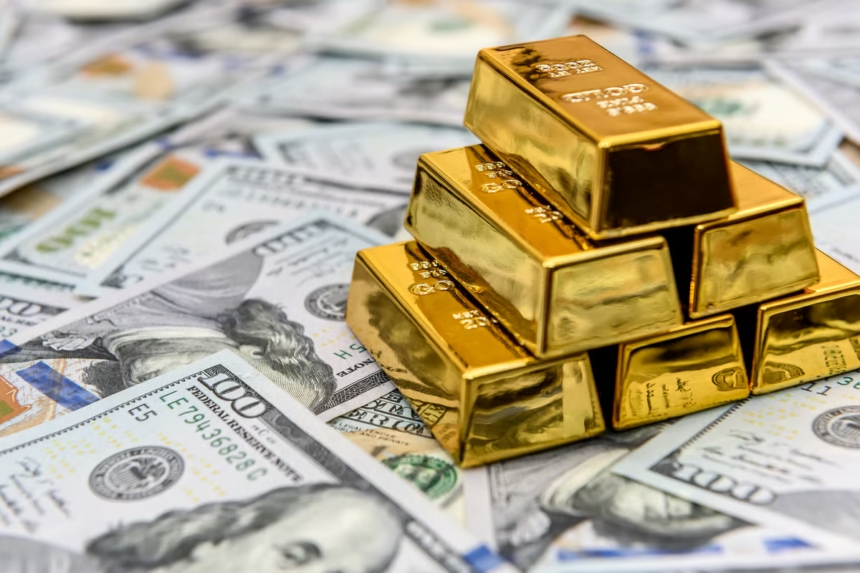
Some of the world’s top investors are currently advocating for increased investments in gold, emphasizing that diversification remains essential for success in any portfolio strategy. Gold, recognized as a longstanding store of value, has maintained its status for thousands of years, rendering it a legal tender in various U.S. states even today. However, its practical use in everyday transactions has dwindled, particularly as its price per ounce has surged sharply.
In a striking market shift, the price of gold increased by an impressive 64% in 2025 and has already risen another 18% in 2026. In stark contrast, the S&P 500 stock market index has seen only a modest increase of 1% this year. The recent surge in gold prices has driven investors towards this precious metal as a safeguard against escalating government spending, mounting national debt, and overall economic uncertainty. Such significant price gains are not typical, but current conditions appear to favor further increases.
Investors looking for reliable returns may find buying physical gold to be the most direct approach as its value climbs. However, many might consider purchasing an exchange-traded fund (ETF), such as the SPDR Gold Shares ETF, which can be a more straightforward investment without the logistical challenges of storing and insuring physical bullion.
One important factor contributing to gold’s appeal is the rising money supply, which could drive up gold prices. The metal’s longstanding reputation as a valuable asset is largely due to its relative scarcity; only about 219,890 tons have been extracted throughout human history, while commodities like iron ore and coal are found in billions of tons. Even more abundant than gold is silver, with approximately 1.7 million tons mined to date.
The global consensus surrounding gold’s value is underscored by the consistent buying habits of investors, governments, and central banks. Historically, many nations pegged their currencies to gold, a practice known as the “gold standard,” which limited the paper money supply based on the amount of physical gold held.
The U.S. operated under the gold standard until 1971, after which there was a marked increase in the money supply. Since then, the U.S. dollar has lost about 90% of its purchasing power. Consequently, even though gold does not generate revenue or earnings, its dollar value has significantly appreciated.
In response to concerns over the growing money supply and an unsustainable fiscal trajectory, investors have rapidly increased their gold purchases over the past year. For example, during fiscal 2025, the U.S. government reported a budget deficit of $1.8 trillion, pushing national debt to an unprecedented high of $38 trillion. Notable figures like hedge fund manager Ray Dalio have advised investors to allocate as much as 15% of their portfolios to gold as a hedge against inflationary policies. Similarly, billionaire Paul Tudor Jones has turned to the SPDR Gold ETF, citing the historical tendency of civilizations to “inflate away their debt” by increasing money supply.
However, expectations around future returns should be moderated. Over the past three decades, gold has yielded an average compound annual return of about 8%, suggesting that the recent gains might not be sustainable. Meanwhile, the S&P 500 has delivered a notably higher average annual return of 10.7%, highlighting a trend where long-term investments in the stock market have typically outperformed gold.
Recent performance indicates that while gold may excel in the short term and is being buoyed by current economic concerns, the S&P 500 remains a stronger long-term asset. This reinforces the notion that diversification is critical for effective investing. While holding gold may now be prudent, stocks are likely to remain the predominant asset class, especially within a diversified portfolio where gold could comprise a 15% allocation.
For those considering investing in gold, physical ownership poses challenges such as storage, insurance, and liquidity. In contrast, the SPDR Gold Shares ETF provides a practical solution, allowing investors to buy and sell through major trading platforms without the hassle of managing physical assets. Although the ETF has a modest expense ratio of 0.4%, translating to an annual fee of $40 for a $10,000 investment, it remains a cost-effective alternative compared to the complexities associated with owning physical gold.