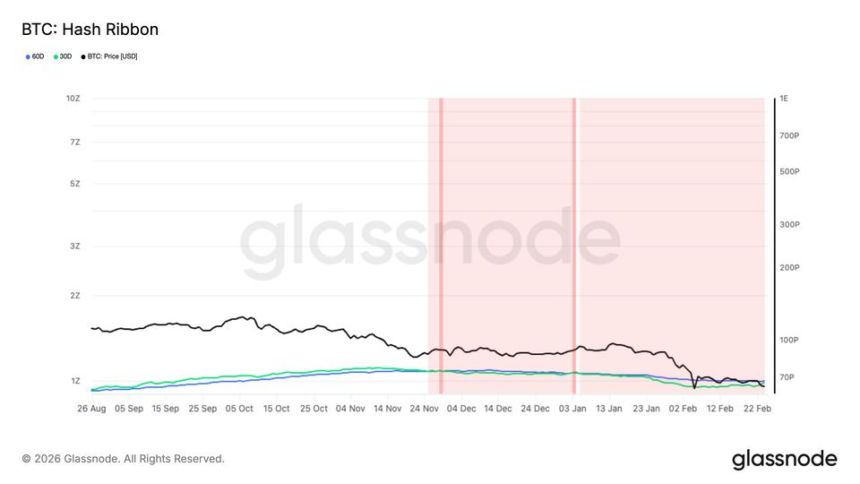
The ongoing volatility in the bitcoin market has sparked interest as indicators suggest that the worst of the recent 50% drawdown may be nearing its end. The Hash Ribbon indicator is approaching a signal that could mark the conclusion of a prolonged three-month period of miner capitulation, a phase now recognized as one of the longest in the cryptocurrency’s history, according to data from Glassnode.
This particular indicator takes into account the 30-day and 60-day moving averages of the hash rate, working on the premise that bitcoin often sees its lowest valuations when miners are under significant financial distress. Capitulation occurs when mining revenues fall below operational costs, compelling less efficient miners to power down their machines and liquidate their BTC reserves to cover expenses such as electricity, debt, and operational overhead. This scenario leads to a decreased hash rate, contributing to sustained selling pressure in the market.
A recovery signal is indicated when the 30-day hash rate moving average surpasses the 60-day average, suggesting that miners are starting to come back online and that the network might be stabilizing. This pivotal moment appears to be on the horizon. Historical patterns have shown that such a crossover, particularly when it coincides with upward price momentum, often indicates strong accumulation periods for investors.
Since the initial inversion of the metric in late November, bitcoin’s valuation has dropped from approximately $90,000 to a low of near $60,000 in early February. As of now, it has staged a mild recovery, approximately trading at $65,000. Major corrections are a known occurrence during miner stress events, with around 20 capitulations observed since 2011. Notably, these events often align with significant local or overall price bottoms, as evidenced in January 2015, December 2018, and December 2022.
Currently, the hash rate—representing the total computational power securing the bitcoin network—is on the rise, indicating a renewed confidence among miners. Additionally, bitcoin is trading below its estimated average production cost of $66,000, a threshold often interpreted as signifying deep value, according to on-chain analytics. This situation mirrors the last time bitcoin was below this production average in November 2022, after which it eventually reached a low near $15,500.
As the crypto community watches these developments closely, many are left to ponder whether the current market phase might herald a significant rebound for bitcoin in the near future.