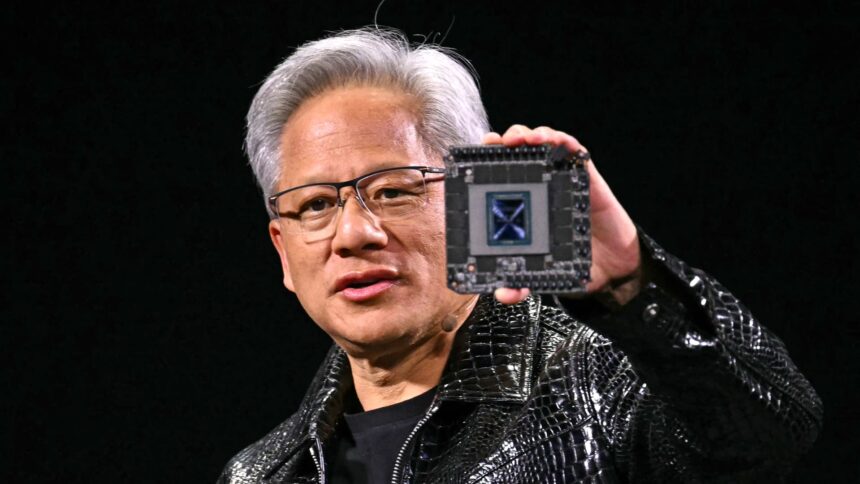
In a recent interview, Jensen Huang, CEO of Nvidia, addressed concerns surrounding the potential impact of artificial intelligence (AI) on the software industry, asserting that market fears may be misplaced. Huang’s comments came on the heels of Nvidia’s impressive fiscal fourth-quarter report, which showed revenue soaring by 73% to $68.13 billion, surpassing analyst expectations of $66.21 billion. Additionally, the company projected an optimistic revenue forecast of $78 billion for the upcoming fiscal first quarter, well above the anticipated $72.6 billion.
During the interview with CNBC, Huang emphasized that he believes AI agents will not replace existing enterprise software but rather enhance it. He referred to this perspective as “counterintuitive,” arguing that AI agents will serve as tool users, effectively utilizing software platforms rather than rendering them obsolete. Huang pointed to traditional tools like internet browsers and Microsoft Excel as examples of technologies that AI can leverage to optimize productivity.
“Nobody’s going to service better than ServiceNow,” he remarked, indicating that specialized software providers would fine-tune AI agents to work with the tools they already offer. He underscored the necessity of such tools for achieving efficient outputs: “We need the tools to finish their work and put the information back in a way that we can understand.”
Despite Huang’s optimistic tone, the immediate aftermath of his statements led to mixed reactions in the software sector. Major companies such as Synopsys and Cadence experienced declines of 3.6% and 0.9%, respectively, during after-hours trading. Meanwhile, ServiceNow remained stable, and SAP’s shares slightly increased by 0.3%.
Investor sentiment remains uncertain, particularly amid fears regarding a possible bubble in AI spending. Dan Niles, the founder of Niles Investment Management, cautioned that while some companies will thrive, others are at risk of failing as AI reshapes workflows and lowers entry barriers for new competitors. “There’s some real companies that are going to go to zero in the software space,” he stated, although he noted that database and cybersecurity firms might prove resilient.
The concerns over AI’s potential to disrupt the software industry have contributed to a 23% decline in the S&P 500 software and services index this year. However, CNBC’s Jim Cramer provided a contrasting viewpoint, arguing that fears of AI decimating software companies are exaggerated. He suggested that the software industry is adaptable and capable of mergers and other strategies to navigate market changes. Cramer noted, “The software companies are survivors,” emphasizing their resilience despite current pricing pressures.
Nvidia’s stock, in contrast to the broader software market, saw a 2% uptick in after-hours trading following the earnings announcement. Huang’s assertions, alongside Nvidia’s prosperous outlook, have sparked a broader conversation about the intersection of AI and software, highlighting both the opportunities and challenges that lie ahead in the evolving technological landscape.