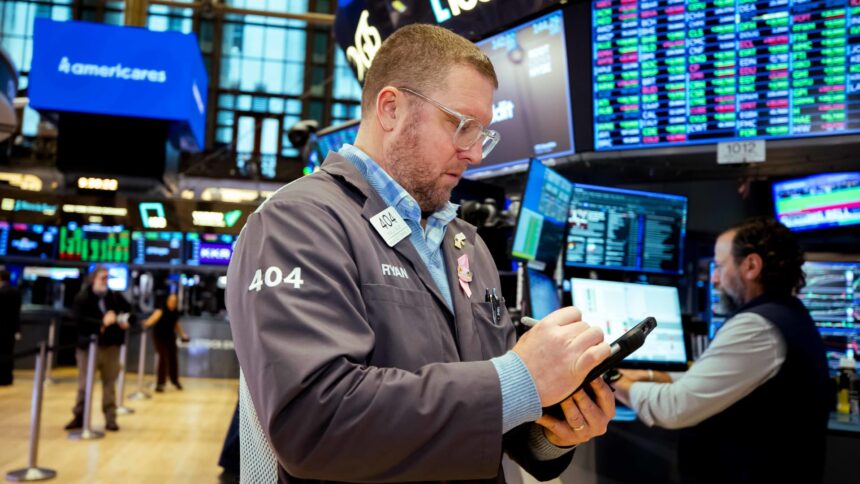
Traders on the New York Stock Exchange faced a challenging session on Thursday, as stock futures dipped following a lackluster performance by major indices. The S&P 500, influenced heavily by a downturn in tech stocks, closed down by 0.5%. Futures linked to the Dow Jones Industrial Average fell by 268 points, approximately 0.5%. Similarly, S&P 500 futures and Nasdaq 100 futures declined by 0.4% each, indicating a cautious sentiment among investors.
The market reaction was particularly pronounced in the technology sector, where stocks such as Salesforce and Microsoft experienced notable declines. Salesforce plummeted over 2%, while Microsoft lost around 1%, contributing to the weakness in Dow futures. Cybersecurity firm Zscaler saw a dramatic nearly 10% drop after reporting lower than expected deferred revenue and billings in its fiscal second quarter, further muddling the tech landscape. CoreWeave also reported disappointing guidance, experiencing an 8% decline.
Nvidia, a key player in the tech sector, reported a surprising 5.5% loss despite a strong fourth-quarter earnings report that had previously garnered investor optimism. Analysts attributed Nvidia’s decline to uncertainty surrounding its partnership with OpenAI, as well as general wariness over the financial implications of artificial intelligence investments, especially among large-scale cloud service providers. “A beat-and-raise earnings report from Nvidia signaled robust demand for AI capital expenditures, but stocks are tanking anyway amid a lackluster mood on Wall Street,” noted Jose Torres, a senior economist at Interactive Brokers. The overall mood reflects broader concerns regarding the technology sector as investors speculate on its growth trajectory amidst recent advancements and volatility in AI-based investments.
Despite the downturn in the tech sector, some investors turned toward more cyclical market segments, with financials and industrials emerging as top performers during the session. However, underlying tensions related to former President Donald Trump’s tariff policies and the geopolitical climate concerning U.S.-Iran relations weighed on sentiment. Sameer Samana, head of global equities and real assets at Wells Fargo Investment Institute, mentioned that investors are becoming more cautious as uncertainties mount. Nevertheless, he expressed confidence that economic growth and corporate earnings would ultimately lead the S&P 500 to break through current resistance levels.
Attention now turns to Friday’s anticipated release of the producer price index (PPI), a key gauge of wholesale inflation. Economists surveyed by Dow Jones forecast a headline reading of 0.3%, with core PPI—excluding volatile energy and food prices—expected to mirror this figure. As February concludes, the month has proved rocky for tech stocks, with the Nasdaq Composite on track for a 2.5% drop, marking its worst monthly performance since March of the previous year. Meanwhile, the S&P 500 is expected to end the month down 0.4%, although the Dow is projected to show a 1.2% gain.