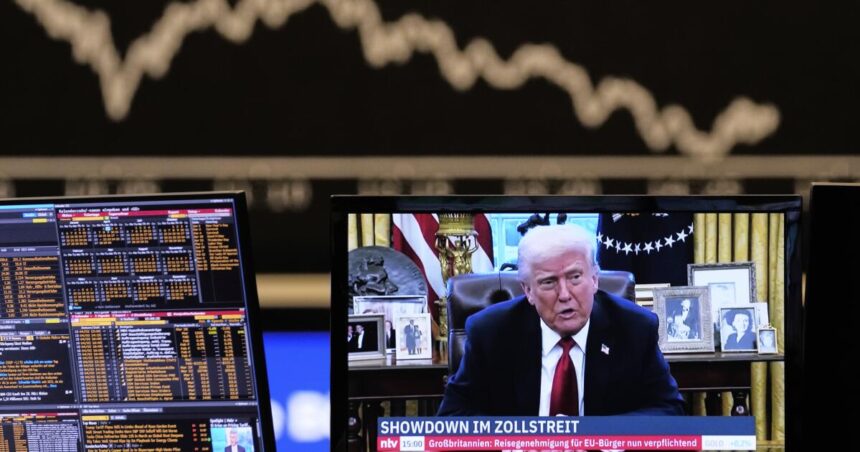
During the presidency of Donald Trump, his administration frequently highlighted the performance of the U.S. stock market as a measure of economic success. However, in 2025, a remarkable shift occurred as investors began to look beyond the U.S. markets for more promising investment opportunities. The Standard & Poor’s 500 index recorded a solid gain of 17.9%, but this was overshadowed by the performance of international markets. The MSCI World ex-USA index demonstrated a robust growth of over 32%, nearly double that of the U.S. markets.
This significant deviation from prior trends has raised eyebrows among investors and analysts alike. Historically, since 2013, the MSCI U.S. index outperformed the non-U.S. index virtually every year, with the exception of 2017 and 2022. In 2024, for example, the U.S. index boasted a gain of 24.6%, while international markets managed a modest 4.7%. The recent performance indicates a dramatic reversal, as the U.S. ranked 21st out of 23 developed markets in 2025, with only New Zealand and Denmark faring worse. In contrast, Austria and Spain achieved impressive gains of 86%, while several other countries, including Finland, Ireland, and Hong Kong, recorded increases of 50% or more.
Investment analysts attribute this shift to various factors. One key issue is the high valuation of U.S. equities relative to international counterparts. The S&P 500 index traded at around 23 times expected corporate earnings, significantly above the historical average of 18 times. Additionally, there is growing unease among investors regarding the heavy reliance on tech sector growth, particularly companies involved in artificial intelligence. Concerns about a potential bubble in AI investments have led many to seek more diversified opportunities outside the United States.
The shadow of Donald Trump looms large in these analyses. As 2025 began, many investors anticipated the potential benefits of Trump’s alleged commitment to deregulation and his assertive stance on maintaining America’s lead in global markets. However, a burgeoning trend of avoidance emerged. “The Trump trade is dead. Long live the anti-Trump trade,” wrote Katie Martin of the Financial Times, highlighting a shift in investor sentiment that increasingly leaned toward international markets.
Two primary elements of Trump’s policy initiatives have raised concerns among investment experts. Firstly, his fluctuating stance on tariffs created uncertainty regarding international trade, with the Supreme Court’s nullification of many tariffs failing to stabilize investor confidence. Trump’s threats of new tariffs only amplified this anxiety. Secondly, ongoing pressures from Trump for lower interest rates contributed to a weaker dollar. A depreciated dollar makes U.S. assets less appealing to international investors, further dampening enthusiasm for U.S. markets.
Analysts have noted that the current climate of uncertainty is largely artificial, driven by a singular figure whose policy decisions could influence capital allocation strategies, particularly as mid-term elections approach. Furthermore, Trump’s administration has frequently touted stock market gains as indicators of economic success. In his State of the Union address, Trump stated that the stock market had reached 53 record highs since his inauguration and claimed that Americans’ retirement accounts were thriving. However, these assertions have been challenged by retirement professionals who reported more modest growth in 401(k) balances during the same period.
Utilizing various metrics, analysis reveals a striking contrast between U.S. and global investments. An investment of $48,488 in the Dow on Trump’s inauguration day would have grown to approximately $50,000 by February 6, 2025, a mere gain of about 3.2%. In comparison, a similar investment in international markets would have yielded nearly $60,000, reflecting a gain of around 24%.
As 2025 progresses, the divergence appears to persist. The S&P 500 has managed a modest gain of approximately 0.74%, while the MSCI World ex-USA index surged by about 8.9%. This indicates the most significant advantage for global stocks relative to the S&P 500 in nearly three decades.
Diverse economic conditions continually reshape investment landscapes, and there is potential for fluctuations between U.S. and international markets throughout the year. Despite this uncertainty, one constant remains: Trump is set to continue as president until January 20, 2029, compelling investors to strategize based on this elongated outlook.