This week has seen significant developments across various sectors, particularly in real estate and the streaming industry, indicating a transformative market landscape. A billion-dollar debut in real estate investment trusts (REITs) and strategic maneuvers highlight the continued evolution of investment opportunities.
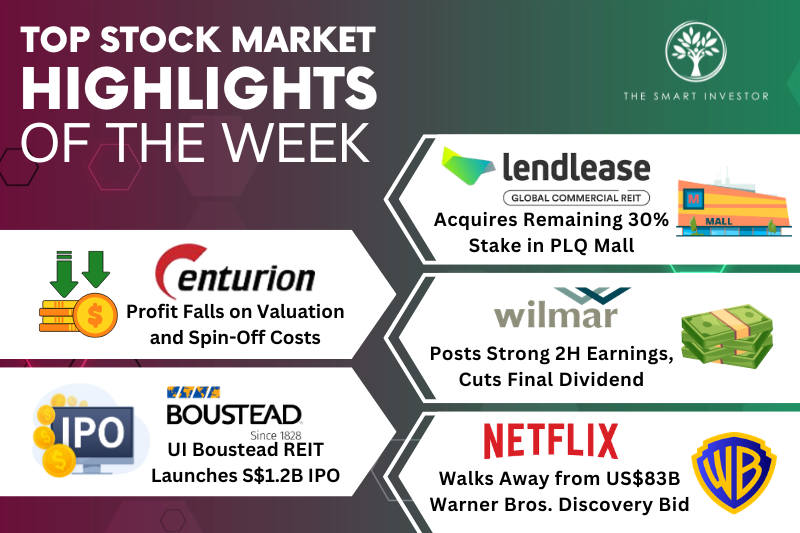
Lendlease Global Commercial REIT (SGX: JYEU), known as LREIT, has consolidated its ownership of the Paya Lebar Quarter (PLQ) Mall by acquiring the remaining 30% stake for S$116.4 million. This comes after the REIT initially purchased a 70% interest in 2025, bringing the total valuation of the retail asset to S$885 million. With full ownership now secured, LREIT gains operational autonomy over a high-occupancy suburban hub that boasts a remarkable 99.4% occupancy rate. This strategic move is projected to enhance the distribution per unit (DPU) by 2.1%, driven by an estimated savings of around S$2 million annually. The acquisition funding will stem from a S$196.6 million non-renounceable preferential offering, marking a significant reinforcement of LREIT’s foothold in Singapore, now with domestic assets making up 90% of its holdings.
In contrasting news, Centurion Corporation (SGX: OU8) revealed a staggering 67% year-on-year decline in net profit for FY2025, amounting to S$114.8 million. This dramatic drop was primarily influenced by non-cash accounting adjustments, particularly a significant decline in fair-value gains on investment properties, which plummeted to S$22.9 million from S$219.1 million the previous year. Additionally, one-off costs related to the spin-off of Centurion Accommodation REIT (CAREIT) adversely impacted the results. However, the company’s operational strength remains impressive, with revenue increasing by 17% to S$295.9 million, supported by nearly full occupancy rates in both Singapore and the UK. The board responded to this resilience by increasing the total yearly dividend to 4 cents, leveraging the successful CAREIT listing as a vehicle for ongoing asset recycling.
Agribusiness leader Wilmar International (SGX: F34) announced a robust 38.3% increase in net profit for the second half of 2025, totaling US$815.9 million. Growth was driven by improved margins across the Feed and Industrial Products segment, alongside gains in sugar merchandising. Overall, Wilmar’s net profit surged by 20.6% for the full year, reaching US$1.41 billion despite encountering global supply chain challenges. The company attributed part of its success to a significant re-measurement gain from AWL Agri Business. However, management has taken a cautious approach for 2026, proposing a reduced final dividend of S$0.10 due to economic uncertainties and potential trade tensions. While demand for palm oil remains strong, challenges such as compressed margins in the tropical oil sector and ongoing legal issues in China pose risks. Wilmar is now focusing on high-margin consumer products to stabilize its growth trajectory.
In the IPO space, the Singapore Exchange (SGX: S68) is preparing for the launch of UI Boustead REIT (SGX: UIBU), aiming to raise S$1.2 billion at an offering price of S$0.88 per unit. The initial portfolio will consist of 23 diversified assets spanning Singapore and Japan, including high-spec industrial spaces like the Razer Southeast Asia Headquarters. Backed by United Industrial Corporation and Boustead Projects, the REIT boasts a strong roster of cornerstone investors, including Amundi and JP Morgan, and is attracting attention due to an anticipated annualized distribution yield of 7.8% for FY2026/27. Its growth strategy is underpinned by a substantial 19.6 million square foot acquisition pipeline and built-in rental escalations, reflecting a positive outlook for modern logistics and business parks amid a tightening interest rate environment.
Meanwhile, Netflix (NASDAQ: NFLX) has officially withdrawn from its pursuit of Warner Bros. Discovery (NASDAQ: WBD) after the board favored a competing proposal from Paramount Skydance Corp (NASDAQ: PSKY). Netflix opted for financial prudence over an escalated bidding war, which resulted in a rally of its shares as investors welcomed the decision to focus on balance sheet health. This withdrawal reshapes the streaming industry, potentially allowing a merger between Paramount and WBD, which would create a significant media entity with extensive content libraries. Despite losing the opportunity to acquire marquee assets, Netflix is doubling down on its organic content strategy with a budget of US$20 billion to maintain its leadership position in profitability.
As the market continues to shift, several Singaporean firms have demonstrated resilience in navigating global economic challenges, maintaining their dividend payouts and strategic growth plans amid increasing complexity. these companies stand as pillars of stability in an otherwise unpredictable landscape.