The recent escalation of conflict involving the U.S. and Israel targeting Iran has sent shockwaves through global markets, leading to significant declines in U.S. futures and a surge in oil prices. On Monday, U.S. futures for both the S&P 500 and Dow Jones Industrial Average fell by over 1%, with the S&P 500 futures dropping 1.7%.
Oil prices reacted sharply to the heightened tensions, with U.S. benchmark crude increasing by approximately 9%, reaching $73 per barrel, while Brent crude rose nearly 10% to approach $80 per barrel. This spike in oil prices highlighted concerns among traders about potential disruptions to oil supplies, particularly given the geopolitical vulnerabilities in the region.
European markets mirrored the anxiety, with Germany’s DAX dropping 2.2% to 24,737.47, and France’s CAC 40 falling 1.9% to 8,413.91. The UK’s FTSE 100 also declined, albeit by a smaller margin of 1% to 10,800.63.
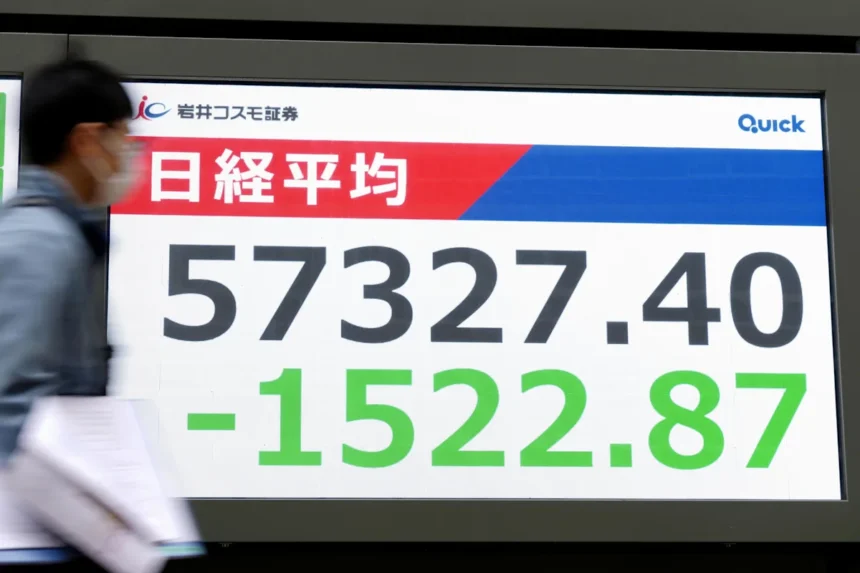
In Asia, market responses were mixed. The Shanghai Composite index increased by 0.5% to 4,182.59, partially buoyed by gains in oil company stocks like CNOOC and PetroChina, which hit the 10% trading limit due to the rising oil prices. Conversely, Hong Kong’s Hang Seng index experienced a drop of 2.1% to 26,059.85, while Japan’s Nikkei 225 fell initially by over 2%, ultimately closing down 1.4% at 58,057.24. Australian markets saw minimal activity with the S&P/ASX 200 ending flat at 9,200.90.
Investor sentiment in India reflected growing concerns over potential oil supply disruptions, with the Sensex declining by 2.1%. Taiwan’s benchmark dropped by 0.9%, and Singapore’s market fell by 2.3%. In Bangkok, a key destination for Middle Eastern tourists, the stock exchange closed lower by 3.1%. Notably, markets in South Korea were closed due to a national holiday.
In a trend typical of uncertain market conditions, gold prices rose by 3.4% to around $5,426 per ounce, as investors flocked to safer assets. The U.S. dollar strengthened, increasing against the Japanese yen to 157.20 from 156.27. However, the euro weakened slightly, moving to $1.1708 from $1.1762.
The conflict raises fears that oil flows could be significantly compromised. Analysts highlight that a substantial portion of global oil and liquefied natural gas (LNG) transits the Strait of Hormuz, making this waterway critical to energy supplies. Estimates suggest that around one-fifth of the world’s energy flows through this narrow passage, emphasizing the potential global economic ramifications of further military actions.
Iran, which exports approximately 1.6 million barrels of oil daily, predominantly to China, could face additional pressures on its oil market if conflict escalates, creating further upward pressure on energy prices.
Despite the immediate turmoil, market responses were somewhat tempered, as the escalation was largely anticipated due to a significant buildup of U.S. military forces in the region. Traders had preemptively adjusted their strategies in light of this risk.
Additionally, inflation concerns in the U.S. were exacerbated by new data showing wholesale inflation surged to 2.9% last month, significantly outpacing economists’ expectations of 1.6%. This has implications for the Federal Reserve’s monetary policy, potentially delaying interest rate cuts that could stimulate the economy but also risk fueling inflation further.
As traders digest the implications of the ongoing conflict alongside broader economic indicators, market volatility is likely to persist, reflecting the fragile balance of investor sentiment in the face of geopolitical uncertainties.