Qatar has announced a significant halt in its liquefied natural gas (LNG) production following recent drone attacks attributed to Iran, which targeted two of the nation’s key energy facilities. This escalation marks a shift in Iran’s military tactics as it broadens its retaliatory campaign against its Gulf neighbors, particularly in response to strikes that resulted in the death of Iranian Supreme Leader Ayatollah Ali Khamenei.
According to Qatar’s Defense Ministry, two drones launched from Iran specifically struck facilities located at Ras Laffan Industrial City and Mesaieed Industrial City, integral to the nation’s LNG operations. Fortunately, there were no reported casualties from these attacks. QatarEnergy, the state-owned energy company, confirmed the impact on production capabilities due to the strikes.
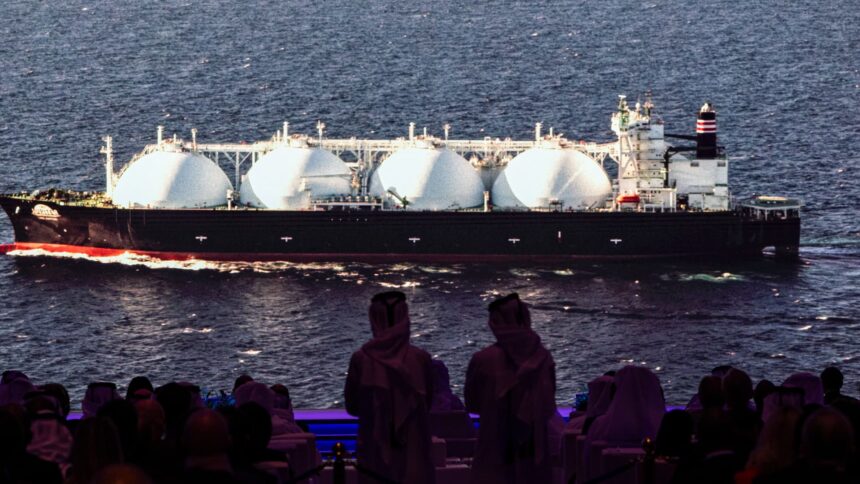
This disruption comes at a pivotal time for global energy markets, as Qatar ranks among the top providers of LNG, contributing approximately 20% of the world’s LNG exports. Most of these exports are transported through the crucial Strait of Hormuz.
In immediate response to the shutdown of production, European natural gas futures experienced a considerable spike. In the UK, natural gas prices surged by nearly 50%, while Dutch futures rose over 45%. Additionally, shares of U.S. LNG exporters saw a notable increase, with Cheniere Energy jumping around 6% and Venture Global soaring over 14%.
In a wider context of regional tension, the drone strikes were part of a series of retaliatory actions by Iran against U.S. allies in the Gulf. The Iranian military has reportedly launched missiles targeting various locations, including a significant assault on Saudi Aramco’s Ras Tanura refinery, which was temporarily closed as a precaution.
Natural gas, a crucial resource primarily used for electricity generation, is produced by cooling the gas to minus 260 degrees Fahrenheit, turning it into a liquid state and allowing for efficient transport. This recent escalation in hostilities underscores the fragile nature of energy supply chains in the region and raises concerns over future production stability amidst geopolitical conflicts.