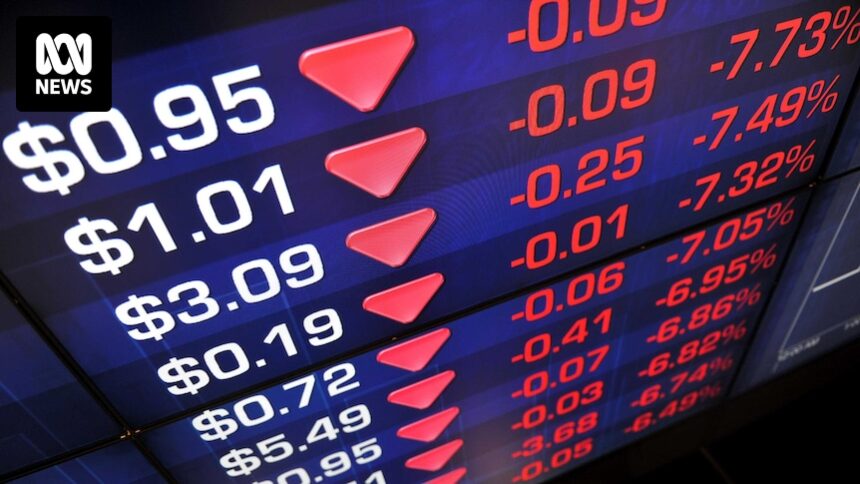
The Australian share market saw a notable decline, with the ASX 200 finishing down 1.9% at 8,901 points. This marked the worst fall for the index since early February, with all sectors registering losses. Of the 200 stocks listed, only 32 managed gains, while a significant 163 ended lower. Technology surfaced as the least affected sector, retracting only 0.2%, while materials plummeted by 2.9%, followed closely by consumer staples and financials down by 2.3% and 2% respectively. Among individual stocks, BlueScope Steel and Xero emerged as rare gainers, increasing by 2.6% and 2.4%. In stark contrast, Silex Systems experienced a substantial drop of 9.7%.
Concurrently, the Australian dollar mirrored market sentiments, declining 0.5% to trade at 69.95 US cents. The performance was reflective of global trends, as major indices in the US and Europe also struggled. The Dow Jones saw a drop of 0.8%, and both the S&P 500 and Nasdaq fell by 0.9% and 1% respectively. In Europe, the FTSE slumped by 2.8%.
On the commodities front, precious metals saw gains with gold rising by 1.3% to $5,154 an ounce, and silver climbing 2.9% to $84.41 an ounce. In contrast, oil prices experienced a moderate increase, with Brent crude reaching $82.70 a barrel, while iron ore ticked down by 0.2% to $99.40 per tonne. Bitcoin also reflected the overall market sentiment with a slight decline of 0.5% to $67,732.
In response to mounting anxieties amid the ongoing Middle East conflicts, long queues formed at petrol stations across Australia, prompting authorities to assure citizens of a stable fuel supply. Nevertheless, accusations emerged against fuel companies for inflating prices amid heightened consumer anxiety.
In another domain, distrust in telecommunications provider Optus surged following a tragic Triple Zero outage last year, which resulted in fatalities. Despite being heralded as a leading brand in trust, hardware giant Bunnings maintained its crown as the most trusted Australian brand, while Woolworths continued to grapple with reputational damage, holding the position of the least trusted retailer.
As the ongoing conflict in the Middle East disrupted $15 billion in Australian meat exports, farmers were also bracing for potential increases in fertilizer prices. This economic turbulence reflects broader global market concerns, with analysts suggesting that geopolitical tensions are likely to burden equity markets further.
Goldman Sachs’ CEO remarked on the relatively muted reaction of financial markets to the Middle Eastern turmoil, suggesting that a deeper assessment of the impacts will unfold over the coming weeks. He noted that despite the uncertain geopolitical backdrop, the overall economic trajectory in the US remains robust due to strong macroeconomic indicators.
In monetary policy, analysts predicted the Reserve Bank of Australia would maintain the cash rate at 3.85% in March, pending further evaluations of inflation data due later in April. This sentiment was echoed by Capital Economics, which highlighted the likelihood of further tightening given Australia’s above-trend growth signals.
Overall, the market’s current volatility reflects a culmination of international conflicts, inflationary pressures, and shifting consumer sentiments as Australians navigate these turbulent economic waters.