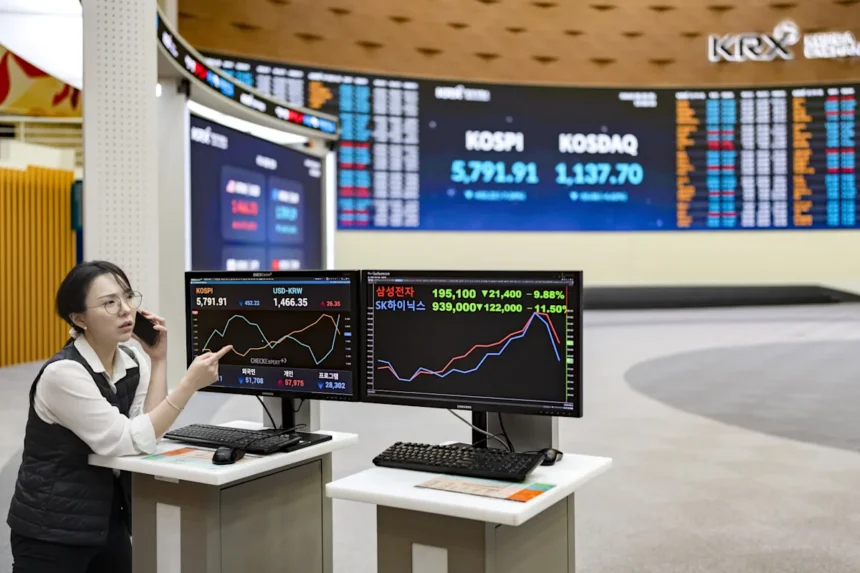
Panic has gripped South Korea’s trading floors as the ongoing conflict in the Middle East has led to unprecedented turmoil in the country’s stock market. The Kospi Index experienced a staggering 12% decline on Wednesday, following a 7.2% drop the previous day, resulting in the heaviest selloff in history for the nation’s equities. Major companies, including Samsung Electronics, SK Hynix, and Hyundai Motor, faced significant losses, prompting a 20-minute trading halt early in the session. Out of more than 800 stocks on the benchmark, only 10 managed to close in the positive.
This turmoil follows a period of heightened optimism driven by advancements in artificial intelligence and strong demand for memory chips, which had previously encouraged retail investors to leverage their investments. Analysts had been bullish on Korean equities, with many raising their forecasts. However, the onset of the Iran conflict has tarnished this optimism, causing widespread concern over potential inflation driven by rising oil prices.
With margin debt hitting record levels, the selloff has become more pronounced. The heavy leverage that initially amplified gains is now exacerbating losses, with forced liquidations occurring as stocks continue to plummet. “Moves are too extreme, so forecasting feels almost impossible — analysis doesn’t really help,” remarked An Hyungjin, CEO of Billionfold Asset Management. Retail traders, observing the unpredictable market conditions, have also begun to retreat, with bids gradually fading.
The considerable rise in margin debt and investor deposits at brokerages indicates that previous market exuberance may have led to excessive risk-taking. Analysts note that many investors had only contributed 30%-40% of the needed capital to secure their positions in heavyweight stocks. Kim Dojoon, an investment officer at Zian Investment Management, highlighted the potential fallout: if prices continue to decrease, investors may resist the urge to “catch a falling knife.”
Amid these developments, economic uncertainties are growing, particularly as traders anticipate two potential rate hikes by the Bank of Korea to combat inflationative pressures. Given South Korea’s vulnerability to energy price fluctuations, the economic landscape remains precarious.
The question now is whether policymakers will intervene to stabilize the market. The administration of President Lee Jae Myung has been proactive in promoting equity investment as a means to address various economic challenges. Recently, the president signaled a personal commitment by putting his apartment for sale, aligning with efforts to encourage investment in stocks rather than real estate. Financial Services Commission Chairman Lee Eog-weon reassured the public that measures, including a 100 trillion won market stabilization program, would be implemented to address excessive volatility.
Despite the recent downturn, the Kospi is still up 21% for the year, maintaining above the 5,000 threshold that was part of President Lee’s campaign promises. While the broader macroeconomic conditions appear favorable—with robust chip shipments boosting exports and rising consumer sentiment linked to equity market gains—certain sectors have shown resilience. Energy stocks such as Daesung Energy, Kukdong Oil & Chemicals, and Korea Petroleum Industries managed to rise by approximately 30% on an otherwise bleak trading day.
Adding a glimmer of hope, foreign investors net purchased 231 billion won (approximately $157 million) worth of Kospi stocks after significantly offloading positions in the previous two sessions. This influx of capital might create selective opportunities for investment in companies and industries currently experiencing attractive pricing amidst the volatility, according to Park Sojung, a portfolio manager at Matthews Asia. Sectors like defense and shipbuilding could also benefit from the ongoing global instability and elevated strategic significance for South Korea.