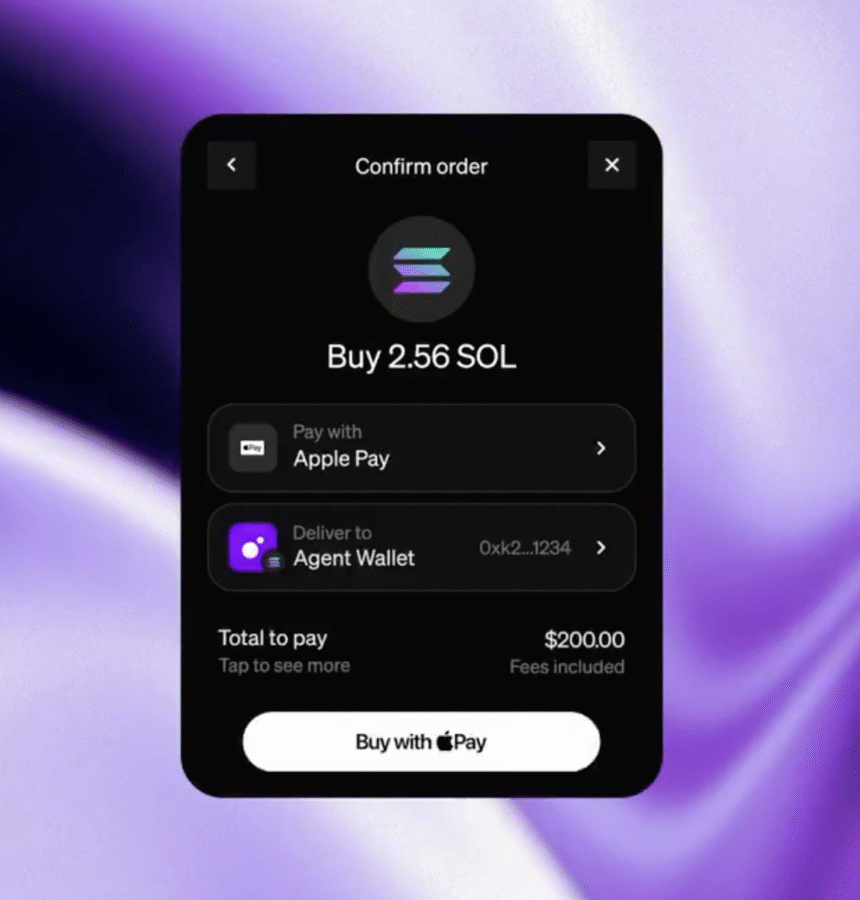
AI agents have evolved significantly beyond their traditional roles of merely answering queries or generating textual outputs. They now possess the capability to engage in trading, manage portfolio rebalancing, and execute various financial strategies autonomously. However, a vital element was previously missing—access to capital.
In a groundbreaking development, MoonPay has unveiled MoonPay Agents, a non-custodial financial framework that empowers AI agents to hold digital wallets, access funds, and conduct on-chain transactions independently. This shift facilitates a seamless transition from mere analysis to active execution.
Historically, AI agents have been restricted by their inability to handle value and move capital, limiting their potential in financial markets. MoonPay Agents eliminates these roadblocks, enabling a comprehensive financial ecosystem for AI agents that includes funding, transactions, and converting assets back to fiat currency. By verifying and funding an agent’s wallet via MoonPay, users grant these agents full autonomy to conduct trades, exchange tokens, and manage funds without requiring constant approval, all while maintaining a non-custodial and permissionless structure.
The system operates through MoonPay CLI, a developer-centric command-line interface. With a straightforward installation, developers can create and manage non-custodial wallets hosted on a user’s device, facilitate funding through MoonPay’s global infrastructure, and programmatically execute transactions on the blockchain. Features supported by MoonPay Agents include:
– Fiat-to-crypto funding via global onramps
– Wallet generation and management
– Token swaps, trading, and cross-chain execution
– Recurring purchases to keep agents funded
– Easy off-ramps back to fiat upon strategy completion
Additionally, MoonPay Agents supports machine-to-machine payments through x402 compatibility, allowing for fully automated transactions without human oversight.
Ivan Soto-Wright has emphasized that this launch addresses a fundamental gap in the current AI ecosystem. While AI agents can analyze and make decisions, they previously lacked the ability to act on economic opportunities due to the absence of capital infrastructure. MoonPay aims to bridge the gap between intellectual capability and financial action, positioning cryptocurrencies as the most versatile and programmatic means of facilitating this transition.
This development is not merely a novelty; MoonPay is positioning AI agents as active participants in real financial workflows. The design of MoonPay Agents is intended to support a vast array of functionalities, catering to potentially millions of agents operating in trading, gaming, commerce, treasury management, and other sectors. MoonPay’s infrastructure integrates seamlessly into agent workflows via its CLI, APIs, and additional infrastructure layers. When identity verification is necessary, users need to complete KYC only once, enabling the agent to operate independently on their behalf thereafter.
As MoonPay continues to serve as the financial backbone for nearly 500 companies, it aims to become the go-to financial infrastructure for AI-native systems.
The implications of these advancements are significant. As AI systems transition from being mere tools to becoming active market participants, direct access to capital is imperative. Agents that engage in capital allocation, trading, or treasury management require efficient value access devoid of cumbersome processes, approvals, or custodial bottlenecks. MoonPay Agents streamlines these complexities into a single, programmable layer.
In summary, as AI agents evolve and require capital to function effectively, the need for scalable infrastructure becomes increasingly crucial. MoonPay is positioning itself to be the essential onramp for both AI-capable agents and the financial ecosystem they will operate within.