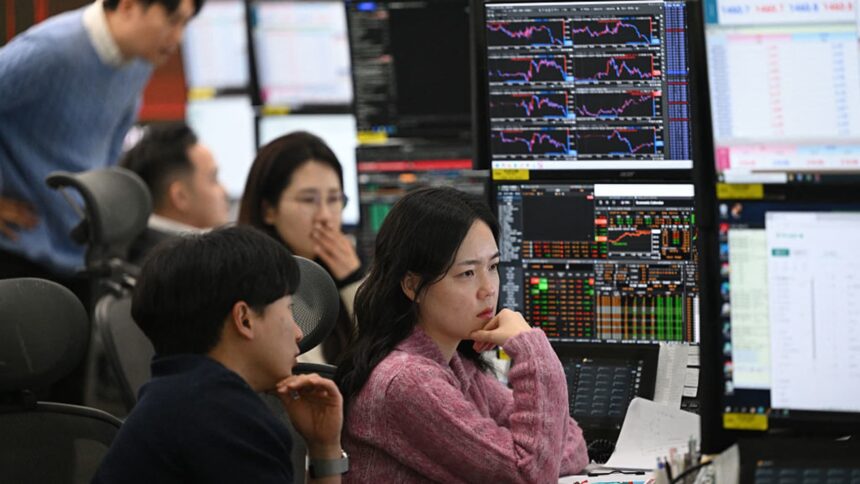
Currency dealers in Seoul reported heightened activity in the foreign exchange market as the landscape of South Korea’s financial sector shifts dramatically. Recent developments saw the benchmark Kospi index experience considerable volatility, characterized by a staggering 12% drop on Wednesday, marking its most significant single-day decline ever. This steep fall was followed by a striking rebound the next day, with a nearly 10% increase, the best performance seen since 2008. The index experienced further fluctuations, trading over 1% lower on Friday.
Investors are grappling with a multitude of pressures, most notably the heightened tensions surrounding the escalating conflict in the Middle East. This geopolitical instability has driven up oil prices, causing ripples throughout global markets. Analysts note that the concentration of South Korea’s stock market in a small number of technology stocks, particularly two memory giants, has made it particularly susceptible to these external shocks.
Jason Hsu, CEO of Rayliant Global Advisors, highlighted that the significant weight of a few technology firms means that any movement in these stocks leads to pronounced effects on the broader market. SK Hynix and Samsung Electronics, which together account for about one-third of Kospi’s market capitalization, have seen substantial gains this year, with SK Hynix rising nearly 45% and Samsung Electronics up about 60% since the beginning of the year.
The volatility has been exacerbated by a surge in leverage among retail investors, as many engaged in margin trading and leveraged exchange-traded funds. Market veteran Daniel Yoo remarked on the impact of large margin calls leading to forced selling during downturns, which amplifies the oscillations in stock prices. According to recent data, retail investors accounted for a significant portion of trading activity, leveraging their investments amidst the market’s instability.
The Kospi Volatility Index spiked to a record high during the sell-off, underlining the market’s tumultuous state. Although it later fell to lower levels, it remained elevated, reflecting ongoing uncertainty. Individual retail investors played a pivotal role in trading dynamics on Thursday, making them the largest buyers, despite also contributing to downward price pressures through sales during the market’s decline.
Furthermore, South Korea’s reliance on imported crude oil adds another layer of vulnerability. As a country heavily dependent on oil imports, the surge in crude prices stemming from geopolitical tensions has a pronounced effect on its market, resulting in significant selling pressure during times of uncertainty.
Despite these challenges, some analysts believe the underlying fundamentals of the South Korean market, particularly in the semiconductor sector, remain robust. There is optimism that demand-supply dynamics in memory chip markets will remain tight, supporting the earnings of leading Korean chipmakers. Analysts maintain that the current choppiness reflects market corrections rather than a fundamental shift, suggesting that the biases in trading could pave the way for a potential recovery should geopolitical uncertainties stabilize.
In summary, while South Korea’s equity market is currently navigating significant turbulence and volatility, particularly due to external pressures and domestic trading behaviors, the long-term outlook for sectors like semiconductors remains cautiously optimistic.