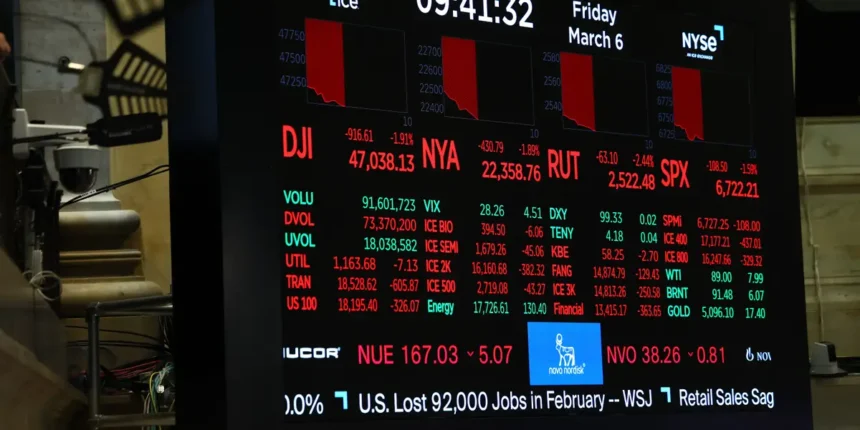
Investors have been issued a warning from Jefferies regarding the ongoing impact of artificial intelligence (AI) on the stock market. The firm’s analysts argue that the surge of fears surrounding AI’s potential to disrupt various industries has resulted in considerable stock sell-offs, leading to some fundamentally sound companies being unjustly deemed as poor investments. Their statement reflects a sentiment shared across several Wall Street firms, noting that while AI is likely to prove disruptive in certain sectors, the reaction from investors has created opportunities to purchase undervalued stocks.
Among the highlighted stocks that Jefferies believes are being unfairly penalized is Sallie Mae (SLM), which has seen a year-to-date drop of 30%. The analysts point out that AI’s influence on the labor market poses risks particularly for recent graduates seeking jobs, which could directly affect Sallie Mae’s credit performance and long-term growth in student loan originations. However, they remain optimistic about the company’s future, suggesting that changes in educational priorities and a potential increase in fee income could lead to a reevaluation of its stock.
Lincoln National (LNC) has also been negatively affected, suffering a 26% decline this year. Jefferies analysts believe that the fears surrounding AI’s potential to disrupt the insurance and wealth management sectors are exaggerated. They foresee AI as a tool that will enhance, rather than replace, the role of financial advisors, ultimately improving cost efficiencies and earnings for companies like Lincoln National. Furthermore, they downplay concerns related to private credit, citing the company’s solid cash reserves and early-stage partnerships with Bain Capital.
Equitable (EQH) has experienced a 21% downturn, influenced by similar AI-related fears. Nevertheless, Jefferies suggests the company has a robust retirement investment portfolio and is likely to benefit from AI-driven efficiency enhancements in the financial sector.
On the technology front, Microsoft (MSFT) has also felt the sting of the market’s AI anxieties, with its stock down 16% this year. Jefferies views this as an overreaction, asserting that Microsoft is strategically positioned to dominate enterprise AI expenditures given its comprehensive platform offerings. Their analysis points to a strong backlog supporting AI demand as a significant positive indicator for the tech giant.
Similarly, Capital One (COF) has suffered a 23% dip in stock price but is being highlighted as a top investment pick by Jefferies, touted as “the most ‘pure’ AI-driven retail bank.” The analysts appreciate Capital One’s integration of proprietary AI and machine learning technology within various operational dimensions, reinforcing its identity as a tech-centric financial institution.
The digital giant Meta (META), which has seen a more modest decline of only 3%, is regarded as a significant beneficiary of AI investments by Jefferies. The firm believes that the company’s extensive user base, data, and talent, combined with upcoming AI initiatives, position it well for future growth.
Finally, ServiceNow (NOW) has faced a 20% drop amid concerns that AI could replace human roles, diminishing demand for its software products. Jefferies considers this response exaggerated and emphasizes the company’s established reputation and integrated AI capabilities as strengths that will mitigate potential risks associated with emerging AI technologies.
In conclusion, Jefferies emphasizes that although fears surrounding AI disruptions are understandable, investors may now find attractive buying opportunities within a range of companies that have been unjustly impacted by these concerns.