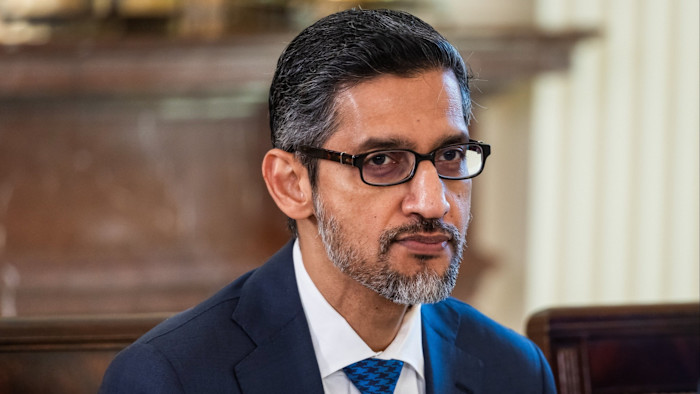
In a significant move to bolster retention and performance incentives, Google has announced a substantial increase in CEO Sundar Pichai’s potential pay, now totaling $692 million over the next three years. This package positions Pichai among the highest-paid executives globally.
A large portion of this compensation consists of performance stock units (PSUs), with a target value of $126 million allocated evenly across two tranches. The value of these PSUs is contingent upon Alphabet, Google’s parent company, achieving favorable total shareholder returns compared to other companies in the S&P 100. Under this structure, Pichai could see these units yield as much as $252 million should the company significantly outperform expectations, or receive nothing if it falls short.
In addition to the PSUs, Pichai will receive $84 million in restricted stock, which will vest monthly over the course of the next three years, conditional on his continued tenure at the firm. His annual salary remains $2 million.
The board also introduced two new stock incentives aimed at fostering growth within Alphabet’s subsidiaries, Waymo and Wing. These bonuses could contribute an additional $350 million to Pichai’s overall compensation, with projected values of $130 million associated with Waymo and $45 million linked to Wing.
Alphabet’s board has expressed that incentivizing Pichai further is essential for the company and stockholders, particularly given the ambitious goals and challenges faced by both Waymo and Wing in their respective sectors of autonomous driving and drone delivery.
Since Pichai became CEO in August 2015, Google’s market capitalization has skyrocketed from $535 billion to approximately $3.6 trillion, even peaking at $4 trillion earlier this year. This impressive growth has cemented Pichai’s status as a billionaire.
Pichai has played a pivotal role in Google’s ascension, having joined the company in 2004 and gaining recognition for his contributions to the development of the Chrome browser and the leadership of the Android division. Despite facing criticism for initially lagging in the AI space, especially after the launch of OpenAI’s ChatGPT in late 2022, he has since made substantial advancements, rolling out advanced AI models and incorporating them into Google’s search operations.
Moreover, Pichai has been at the helm during significant antitrust litigation against Google, adeptly navigating challenges concerning the search engine and app store while managing the threat of potential forced break-ups. A third lawsuit is currently pending regarding the company’s advertising network.
In recent filings, it was revealed that Pichai’s previous stock award was valued at $218 million and that his personal security expenses have escalated to $8.3 million in 2024. Additionally, Pichai recently liquidated 32,500 class C shares valued at approximately $9.8 million and has reportedly sold around $650 million in stock since his appointment as CEO. Together with his wife, Anjali, they control about 1.67 million Google shares worth around $498 million as of recent stock valuations.
Despite being a major figure in the company, Google co-founders Sergey Brin and Larry Page retain control through their super-voting class B stock, which grants them 56% of the decision-making power.
In comparison, Microsoft CEO Satya Nadella earned $96.5 million in fiscal year 2025, while Apple CEO Tim Cook received a total compensation of $74.3 million during the same period.