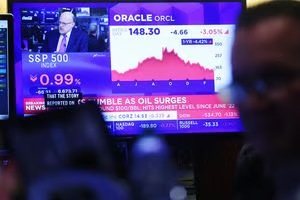
Wall Street’s response to the ongoing conflict in Iran has introduced a wave of uncertainty across financial markets, with JPMorgan Chase now cautioning investors about the potential repercussions. According to a recent report from Bloomberg, Andrew Tyler, head of global market intelligence at JPMorgan, has adopted a “tactically bearish” stance, indicating that U.S. stocks might not be adequately prepared for a significant market correction as the military situation escalates and oil prices soar past $100 per barrel. He estimates that the S&P 500 could face a decline of around 10%, dropping to approximately 6,270.
Despite the alarming trends in oil prices, the market has exhibited an unusual sense of calm, with minimal fluctuations noted thus far. Even Goldman Sachs’ CEO David Solomon has expressed disbelief at Wall Street’s “benign” attitude towards the geopolitical tensions. However, the recent rise in crude oil, which hit $120 a barrel on Monday amid concerns over shipping routes in the Strait of Hormuz, has created a more anxious environment. This has been reflected in falling U.S. stock futures and a spike in the VIX index, which rose to 31.45. The Russell 2000 index even ventured briefly into correction territory.
Over the past week, the price of West Texas Intermediate crude surged by 35%, marking its largest weekly hike since the contract’s inception in 1983. In that same timeframe, the S&P 500 only experienced a modest 2% decline, while the Nasdaq fell just over 1%. This divergence has prompted speculation that investors are prematurely assuming this geopolitical conflict will follow a typical pattern, burning brightly before subsiding without substantial long-term effects.
Adding to the market’s complexity, JPMorgan’s messaging regarding the crisis has shifted notably within days. Their analysts previously characterized major geopolitical shocks as leading to a 5% to 6% market downturn, typically recuperated within weeks. They emphasized the inclination among macro strategists to view geopolitical events simplistically as “buy-the-dip” opportunities. Just last week, JPMorgan’s strategist Mislav Matejka suggested that the current crisis presented a chance to strengthen portfolios based on strong economic fundamentals. However, his outlook has since darkened, indicating that conditions may need to deteriorate further before any stabilization can be expected, while still suggesting that the selloff could be of limited duration.
The urgency of the situation is underscored by the interplay between rising oil prices, inflationary pressures, and growth forecasts. JPMorgan Asset Management pointed out that energy shocks can be particularly detrimental, leading to recessive and inflationary dynamics simultaneously. The Strait of Hormuz is especially critical, as it facilitates roughly one-fifth of the world’s oil supply. Analysts estimate that a complete shutdown could push oil prices well above the $100 mark and trigger significant impacts on U.S. inflation and GDP growth—factors that are already tense, with current inflation standing at 3% and February’s labor statistics indicating a loss of 92,000 jobs.
Moreover, JPMorgan recently issued a cautionary note regarding a potential strike on Iran’s Kharg Island, which handles the majority of the nation’s crude exports. Such an event could drastically curtail oil flows and spark retaliation within the region, exacerbating existing tensions in global energy supply.
In summary, while JPMorgan is not forecasting a catastrophic market collapse, it is signaling that Wall Street may be underestimating the risks posed by an evolving foreign-policy crisis that could pivot into a stagflation scenario. The concerns are real and revolve primarily around energy prices, a vital issue that is increasingly difficult to dismiss.