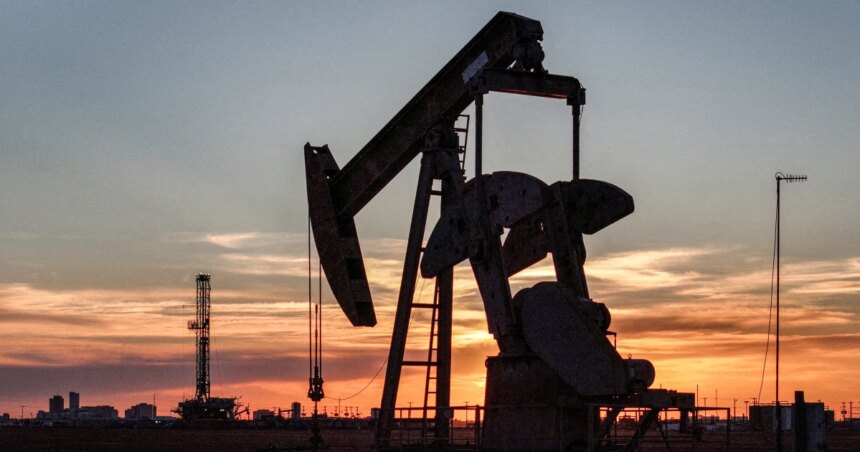
The price of oil experienced a significant surge on Monday following the escalating conflict in Iran, spurring global financial markets’ concerns about rising inflation. U.S. crude oil prices jumped by approximately 31% overnight and were trading up about 5% at midday, hovering around $95 per barrel. Meanwhile, international benchmark Brent crude saw a 6% increase, exceeding $100 per barrel. Since the year began, U.S. crude oil prices have escalated nearly 70%, reflecting a rise of more than 35% within just the last five days.
Industry experts, such as Andy Lipow, predict that the $100-per-barrel mark may serve as a temporary target amid ongoing conflict, as oil production decreases and storage capacities reach their limits due to tankers being unable to load. By noon, the average price of gasoline at U.S. retail outlets soared to $3.47 per gallon, marking an increase of over 50 cents since the onset of the war, according to GasBuddy, a price-tracking service.
The dramatic rise in oil prices has adversely affected stock markets. Although the S&P 500 showed signs of recovery, it was still down 0.5% during early afternoon trading. The Dow Jones Industrial Average experienced a sharp decline of nearly 400 points, while the Nasdaq Composite remained nearly unchanged. In Japan, the Nikkei 225 faced its worst day since April 2025, plunging 5.2% and entering correction territory, defined as a drop of 10% or more from recent highs. Similarly, South Korea’s Kospi index dropped 6%, resulting in a temporary trading halt due to heavy selling activity. European markets also felt the pressure, with the Stoxx 600 index closing down 0.6% as major European markets, including Germany, France, Italy, and Spain, saw declines around 1%.
Global bond markets reflected the turmoil, with the yield on 10-year U.S. government bonds reaching 4.17%, while the 30-year bond yield climbed to 4.78%. Natural gas prices followed suit, with New York futures rising about 2% and European futures increasing nearly 10%.
In light of these escalating prices, finance ministers from leading industrialized nations convened via video conference to deliberate on a potential coordinated release of oil reserves. However, at the close of their discussions, they opted against such an action for the time being. French finance minister Roland Lescure emphasized the group’s commitment to closely monitor the unfolding situation, stating, “We are not there yet,” and affirming their readiness to take coordinated steps to stabilize markets.
The White House also commented on the situation, indicating continual collaboration with relevant agencies to address the oil price crisis. A spokesperson conveyed that President Trump and his energy team had been formulating strategies to maintain energy market stability long before the recent conflict, asserting that the fluctuations in oil prices are expected to be temporary.
Discussions about potential strategies to alleviate rising oil prices included options such as restricting U.S. exports, intervening in the futures market, and temporarily lifting certain regulations that require domestic fuel to be transported on U.S.-flagged vessels.
The International Energy Agency’s executive director Fatih Birol briefed ministers on the state of energy markets, highlighting deteriorating conditions and curtailed oil production. Birol also noted the significant risks posed by disruptions in the Strait of Hormuz, through which over 20% of the world’s daily oil supply flows. The area has faced threats to maritime operations, and several attacks on vessels have been reported, compounding the crisis.
Several countries, including Kuwait, the United Arab Emirates, and reportedly Saudi Arabia, have reduced oil output since the onset of the conflict. Analysts from JPMorgan Chase warned that with bottlenecks unresolved and storage tightening, further production cuts might be necessary. They estimated a need to curtail more than 4 million barrels per day by the following Friday, with around 2 million barrels already being cut.
While no country has completely halted oil production yet, analysts caution that such a scenario could arise soon, with the UAE potentially being the next at risk within days. The ongoing turmoil raises concerns about the ability to quickly restore oil supply if there are extended disruptions. Time is becoming critical as analysts predict that temporary outages may evolve into more sustained supply losses.