U.S. stocks staged a notable recovery from early losses on Monday, buoyed by President Trump’s comments suggesting a potential end to the conflict with Iran. This optimism boosted market sentiment and led to a strong afternoon rebound across major indices. The tech-heavy Nasdaq Composite rose over 1.3%, while the Dow Jones Industrial Average rebounded by approximately 240 points, or 0.5%, after having dipped over 800 points earlier in the day. The S&P 500 also gained 0.8%, marking a firm turnaround as investor sentiment improved.
The market’s upswing was closely tied to President Trump’s assertion that the U.S. was “very far” ahead of the planned four-to-five-week timeline for the resolution of the conflict. In an interview, he stated, “I think the war is very complete, pretty much. They have no navy, no communications, they’ve got no Air Force.” His remarks seemed to reassure investors, leading to an overall positive market environment.
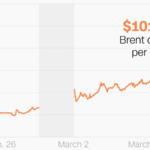
Concurrently, oil prices experienced a sharp decline after briefly surpassing $100 per barrel, a move that initially sent shockwaves through the market. Crude futures had surged earlier, triggering discussions among G7 nations about potentially utilizing the International Energy Agency’s strategic petroleum reserves. However, as the situation evolved with Trump’s hints at measures to curb rising oil prices, optimism returned to the market. Brent crude futures closed above $98 per barrel, while West Texas Intermediate (WTI) settled above $94 after reaching as high as $119 earlier.
Looking ahead, investors are closely monitoring upcoming domestic economic reports, particularly Wednesday’s Consumer Price Index and Friday’s Personal Consumption Expenditures index, though these reports may not fully reflect the recent oil price volatility’s impact on inflation.
Amid the earnings season, companies like Oracle and Adobe are set to capture attention later in the week. In the broader context, the recent volatility in the markets has raised concerns about inflation and its potential impact on the Federal Reserve’s policy decisions.
In the digital asset realm, Bitcoin showed remarkable resilience, bouncing back to approximately $69,000 amid ongoing geopolitical uncertainties. Other cryptocurrencies also witnessed gains, indicating a potential shift in investor sentiment towards these digital assets, despite the surrounding turmoil.
Amid deteriorating market conditions for other sectors, macro strategist Alfonso Peccatiello warned of emerging stress in the bond market which could exacerbate volatility in equities. His points indicated that the potential for forced deleveraging could become a significant risk, affecting investor confidence across financial markets.
In the corporate sector, activist investor Starboard Value targeted Lamb Weston, a major supplier for McDonald’s, urging cost-cutting measures to enhance operational efficiencies. In another significant development, shares of Hims & Hers Health soared following reports that Novo Nordisk would distribute products on its platform, highlighting potential volatility in corporate relationships and market confidence.
The market showed a complex picture, with mixed signals across different sectors. Airline stocks faced pressure due to rising oil prices, which are expected to translate into higher operational costs. Major airlines like Delta and United saw stock declines as market expectations for increased ticket prices loomed. Conversely, some sectors remained resilient, suggesting selective investor optimism amid broader geopolitical challenges.
Overall, the day’s trading reflected a market grappling with significant external pressures, marked by the evolving situation in the Middle East, fluctuating oil prices, and varying investor sentiment across major sectors. The interplay of geopolitical developments and economic indicators continues to shape market dynamics as investors navigate these turbulent waters.